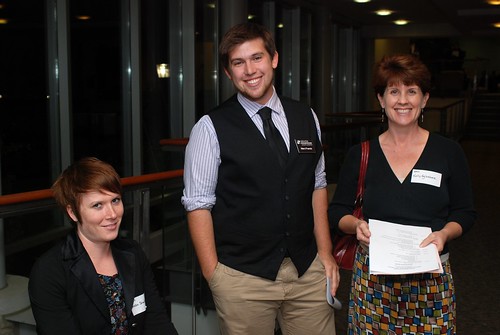
We know you like to hear stories from our AmeriCorps*VISTA members, and why wouldn't you? During their year of service, VISTA members bring passion and idealism to the amazing work they do, and they've been behind the scenes on many of our most successful initiatives.
Because of our long history with national service, GHCC is pleased to announce we are becoming a VISTA sponsor site. This means we will have a number of VISTA slots available and are currently soliciting proposals from qualified organizations in Greater Homewood.
If your organization wants to increase its ability to assist underserved communities, look no further! Your organization may benefit from hosting an AmeriCorps*VISTA (Volunteer in Service to America) member. GHCC is accepting applications from Baltimore City non-profit agencies, service agencies, and community organizations to fill 10 AmeriCorps*VISTA project slots for service terms beginning in July 2011 and ending in July 2012. VISTA members provide one year of full-time service at their host organization.
RFP applications are due on February 22, 2011 by 9:00 a.m.
We will hold an informal pre-proposal workshop on Tuesday, February 8 at 5:30 p.m. at GHCC’s main office (3503 N. Charles Street) for applicants interested in obtaining more information about being a service site.
Think a VISTA service project might be just what your organization needs? Please RSVP to Glenda Garcia at 410-261-3618 or ggarcia@greaterhomewood.org to reserve a space at the workshop.
Click here to download the RFP, and please contact Tyson Smith, Director of Administration and AmeriCorps*VISTA Supervisor (410-261-3509 or tsmith@greaterhomewood.org) or Glenda Garcia, VISTA Leader (410-261-3518 or ggarcia@greaterhomewood.org) with any questions regarding the development of a VISTA project or specific questions regarding this RFP.
Showing posts with label VISTA. Show all posts
Thursday, February 3, 2011
Monday, December 20, 2010
Reflections on a Year of Service: George Shardlow
Last week, GHCC said goodbye to a VISTA member who has brightened our days at the office since November 2009. George Shardlow isn't going far, though: he'll be staying in Baltimore working on transportation issues, so no doubt he'll be hearing from us on a regular basis.
We first met George on Greater Homewood Voices last February, but we caught up with him again to hear his perspective after a full year of service.
You're a Minnesota native and went to school in Iowa—what brought you all the way to Baltimore?
I was pretty intent on getting out of my parents’ basement. I started applying to every VISTA position that seemed in line with my interests. The posting for my current position popped up and seemed quite intriguing.
A Google image search for Baltimore yielded pictures of vacant houses, which struck me as sufficiently different from suburban Minnesota to constitute a legitimate adventure—of course, I’ve since discovered the city’s vibrancy. GHCC called me back after I applied and the next thing I knew, I was on a plane to “Bawlmer.”
Tell us a little bit about your educational background and study abroad experiences. How have they helped you in your VISTA service?
All too often, study abroad is marketed as an opportunity to experience something “foreign.” For me, the most enriching part of the experience was being foreign. You have to develop a comfort level with the fact that you’re different from everyone around you. The unfortunate reality is that many people are unable to acclimate to that environment. I’ve always been sort of odd—even back in Minnesota—so I was never all that upset about being a “gringo.” You learn to not take yourself too seriously and to laugh at all the uncomfortable disconnects.
I say all this simply because there is an extent to which a lot of VISTAs, myself included, are strangers in a strange land. You enter a community you know nothing about and, in the beginning at least, people are not entirely sure what to do with you. I’ve had a lot of fun moving from neighborhood to neighborhood developing a rapport with the residents I met there.
All the clichés about everybody being the same on the inside ring true, but it’s undeniable that there are plenty of quirks between us. Apparently, you Baltimoreans don’t use the word “folks,” as in “how are you folks doin’?” It’s just baffling to me. I’ve enjoyed being a quirky, Nordic oddity and have learned a lot from being here.
Was VISTA your first choice coming out of college? What other options did you consider? How did your family feel about you moving halfway across the country to do a year of service?
As a Political Science major, my first choice was to have someone pay me to just sort of make profound observations about an assortment of topics—turns out that’s not really how it’s done. Always a generalist, I was open to any number of options. In May 2009, the month I graduated, there were a slew of magazine articles harping on the worst job market since post-War Germany, which was certainly…uplifting. VISTA seemed like a good option because it welcomed entry-level applicants at a time when I would have been competing against PhDs to get a job flipping burgers at McDonald’s.
It was also appealing to dedicate myself to something other than just making money. By the time I applied in November 2009, the bailouts were in full swing. The image I was getting of corporate America was of greedy, entitled white dudes who screw up and then rob the American people. I have since moderated this view and, through the course of my service year, become keenly aware of the importance of the private sector for building vibrant communities.
How did my family react? They were supportive. I think they understood that it was time for me to get out of the Midwest and they were happy to see me doing something worthwhile. My father is known for what you might politely call “dark humor,” so my moving to the city where they filmed The Wire provided no shortage of fodder for one-liners—one-liners, it turns out, many Baltimore natives are not entirely fond of. Several members of my family have been out to visit and they have all come to love this city as I do.
Every VISTA year has its ups and downs. What was the toughest thing you had to go through, and what/who got you through it?
There were several points when I did not feel like I was on the front line, per se. I doubted the importance and impact of what I was doing. Indirect service is necessary work, but it’s not always as gratifying and the results are not always immediately apparent. I had to remind myself that community organizing is a marathon and not a sprint and that every little bit helps.
What accomplishment are you most proud of from your year?
Many GHCC staff members got a chance to appreciate your sense of humor during your tenure here. What memory will make you laugh every time you think of it?
A group of staff and VISTA members ran in a mud run in Rockville, Maryland, dressed in brightly colored, full-body spandex suits we ordered online from a Chinese wholesaler. We were pretty much the most popular people at the race and even got interviewed by the Washington Post. Maybe you saw it. It was in section Z, two pages after the profile of Mrs. Salahi’s hairdresser.
That has nothing to do with combating poverty, but it was the highlight of the year.
Give us the outsider’s perspective—when you moved here, what surprised you most about this city? What do you think is its biggest strength?
What was most surprising for me was seeing the stark racial and socio-economic differences between neighborhoods. I’d never had the experience, before coming here, of walking just one block and finding myself in a completely different world. That said, I love the fact that each neighborhood has such a strong identity. Summers in Baltimore are a blast. Not a weekend goes by without a street fair somewhere in this city and each one puts its neighborhood’s flavor on display.
Baltimore’s biggest strength is its pride and sense of self. People are proud to be from Baltimore, and I can see why. There is a certain tough-luck-kid-chip-on-your-shoulder element to it, but more importantly there’s just no place quite like Baltimore. I like that my neighbors sit on their porch and say hello as I walk by. There is a real sense of community within each neighborhood, even at times when bonds across neighborhood lines are not readily formed.
I hope people don’t take this the wrong way, but above all else I think Baltimore is a great place to be weird. I don’t know that I could ever fully articulate what I mean by that, but I know that I love that about this place.
If you could say just one thing to people starting a year of service, what would it be?
Stick with Natty Boh. Resurrection is delicious, but you’re living in poverty and you need to come to terms with the fact that you can’t afford it. Lay off Chipotle for the same reason.
Wednesday, December 15, 2010
Building Capacity in Baltimore Schools
Every winter, education advocates across Maryland hit the streets to educate parents and residents on funding cuts on the table for their neighborhood schools.
The Baltimore Education Coalition (BEC) is made up of organizations from across Baltimore City that improve public schools. GHCC was a founding member of the BEC when it formed in 2009, together with organizations like BUILD, Child First Authority, and the ACLU of Maryland.
Jimmy Stuart is an AmeriCorps*VISTA member working in Success Academy, an alternative high school located at the Baltimore City Schools headquarters on North Avenue. As a VISTA, Jimmy is building sustainability in Success Academy’s programs—he sees firsthand how important adequate funding is to maintaining good schools. VISTA guidelines dictate that Jimmy can’t join BEC, but he can help lay the foundation for an active and engaged group of city residents and parents. Today we caught up with Jimmy to ask him about his work.
You’re an AmeriCorps*VISTA member—what does this mean in terms of restrictions on your personal involvement in advocacy efforts?
As a VISTA, I’m prevented from doing anything that ties the VISTA name or image to a political cause. In my project this year, I’m improving the quality and sustainability of programs provided to students at Success Academy, an alternative high school run by Baltimore City Schools. I’m involved with the BEC because funding for schools is directly tied to the goals of my project. In that capacity, I can inform people in the community about how to get involved with this work. I can talk about the BEC, help run meetings, and organize actions. But the actions themselves have to come from BEC members, not me. Simply put, I can tell people how to get to the bus to Annapolis, but I can’t get on the bus myself.
Your role is all about giving others a voice and making sure Baltimore’s citizens are engaged in the legislative process. How does this make you feel at the end of the day? Do you prefer empowering others over being on the front lines, or is it a struggle not to get your hands dirty?
Even if I was doing direct advocacy, the work would be pointless if we weren’t focused on informing others so they know what it means to be advocates for themselves. The need is too great for anyone to do this alone—Baltimore needs a loud, strong voice for our schools. Funding for education affects me, but many other people in this city are closer to the issue than I am. Providing people who are closest to the problem with the information to affect change is going to yield far better results than anything I could do on my own.
Sure, I’ll be disappointed I can’t get on the buses to Annapolis with our community members. But the experience of inspiring people and getting them to that point is something that I’ll carry with me much longer than that momentary disappointment.
What is your favorite aspect of GHCC’s advocacy work? What have you learned during your tenure here?
What I appreciate most about GHCC’s advocacy work is our awareness of the many different issues affect each other and affect our work. Advocacy often gets broken down into smaller and smaller compartments—you meet people who are passionate about one issue, and one issue only. At GHCC, there’s an understanding that many issues affect our work, and if we want to do our work well, we can’t just plug away on one of them. It all matters.
The quality of our public schools affects us all. Sometimes we think that funding for schools only matters if those schools educate our own children or cut our paychecks. Excellent public schools are critical to building strong and vibrant urban communities. Every family should be excited about sending their children to their neighborhood school. If we want people to invest in this city—to buy and care for a home, to open a quality business, to get involved in their community—we need strong public schools.
Give us a little background on the current education funding crisis and how BEC is trying to help.
It’s an unfortunate fact, but each year school communities are challenged to do more and more with less and less. The state proposes cuts every year, but the cuts this year could be worse than the city has seen in a long time. Not only could the city lose a significant amount of direct funding for schools, but there is a push at the state level to transfer the cost of teacher pensions from the state to local school districts—an incredible expense for city schools to take on.
The state of Maryland is facing a $1.6 billion budget shortfall—a hole in state spending that has been plugged up by stimulus money for the last two years. There is going to be enormous pressure within the state legislature to cut spending—including spending for schools—when the budget is introduced in January.
For this coming budget session, the BEC has three goals: to maintain current funding for Baltimore City Public Schools; to get elected officials to develop a comprehensive funding plan for the school facilities improvement plan proposed by the ACLU; and to encourage Baltimore’s delegates to work better together on protecting our schools.
Tell us a little bit about the advocacy training on Thursday. What do you hope people will come away with?
The event on Thursday is a workshop and action. We have targeted key leaders in our school communities to attend the event. We hope to provide them with a clear sense of the potential funding crisis, and to collaborate on how to get people from our communities involved in preventing cuts and improving school facilities. The event will also be an opportunity to celebrate our schools and to get people fired up about our work.
The pressure to cut funding is going to be very strong this year, and those cuts could be devastating for our public schools. I hope people walk away with a sense of hopeful urgency—that it can be done, but it will require all the strength we can muster to do it.
If you are interested in attending the workshop and action at Digital Harbor High School this Thursday, or learning more about the work of the Baltimore Education Coalition, please contact Jimmy at 410.929.3657 or jstuart@greaterhomewood.org.
Wednesday, November 17, 2010
VISTA Member Vanessa Schaefer Reflects on Her Year of Service
This week we bid a very fond farewell to two of our AmeriCorps*VISTA members who are completing their service on Friday. One of those VISTA members is Vanessa Schaefer, who has spent her year of service at Barclay Elementary/Middle School building mutually supportive connections with the Harwood, Abell, and Charles Village neighborhoods.
Recently we caught up with Vanessa to reflect on her year at GHCC.
You’re originally from Arizona—what brought you all the way out here to Baltimore?
Was VISTA your first choice coming out of college? What other options did you consider? How did your family feel about you moving across the country to do a year of service?
Where are you headed after November? Are you planning on staying in Baltimore?
Recently we caught up with Vanessa to reflect on her year at GHCC.
You’re originally from Arizona—what brought you all the way out here to Baltimore?
I visited a friend in Washington, DC in September 2009 and we took a day trip up here. All my friends in Arizona were moving further west, but I wanted to check out places that hadn’t been explored as much by my group of friends. I felt like Baltimore was a place on the cultural up-swing, yet it was still a smaller city so it didn’t feel totally overwhelming (Phoenix is a big city, but it isn’t condensed like cities on the East Coast). I went home after that trip and started applying to positions out here and two months later I moved!
| Vanessa carrying a scarecrow with Barclay students. |
AmeriCorps was my first choice coming out of college, though I hadn’t decided specifically on VISTA. I had considered other things like Teach for America and Peace Corps, but for various reasons I ended up going with AmeriCorps*VISTA, and I’m really happy with how it all worked out. My family wasn’t too concerned about me moving across the country, but I am very close to my brother, so it was difficult to move the farthest from him that I have ever been.
Every VISTA has a lot of ups and downs during their year. What was the toughest thing you had to deal with, and what/who got you through it?
The toughest thing I had to deal with was that early in my year, I was assaulted while in Washington, DC. Being in the midst of making new friends after having just moved alone across the country and started a new job, this added a whole other level of stress to the situation. What got me through it was making friends and pressing through the red tape to take advantage of the benefits AmeriCorps offers its members. Building a support system and utilizing the few resources you do have as a VISTA cannot be touted enough.
What accomplishment are you most proud of from your VISTA year?
My role in helping to create the Organized Parent Group at Barclay. It is one of the most stable, continuous projects I have worked on. This is something that needed my help to exist in the first place, but now that it does, it has the leadership and the momentum to play a huge role in the workings of the Barclay School and the sense of community amongst the families that come here. Capacity building is at the heart of the VISTA mission, and this was my favorite example of that.
What memory will always make you laugh?
Pretty much any event that required Kelly Oglesbee and me to handle the barbecuing at Barclay.
What is your favorite thing about GHCC?
The employees. I live with two people who were VISTAs during my time and they have been great. The people I work with, both GHCC and Barclay School staff, have made my year really enjoyable. They have also been a source of encouragement: seeing so many people working so hard to make Baltimore a better place has shown me the commitment of the community here and demonstrated real possibility for the future.
| L to R: Vanessa, new VISTA member Marc Francis, and Barclay Community School Director Kelly Oglesbee |
After November, I’m not sure where I'm headed. I am actively looking for job opportunities, but I'm not done traveling yet. I may continue living here and traveling periodically, or I may move to a different state and experience that for a while. Either way, being 23, I don’t feel too terribly anxious about making concrete plans.
Give us the outsider’s perspective—when you moved here, what surprised you most about this city? What do you think is its biggest strength? Biggest weakness?
What surprised me most about Baltimore was how different each neighborhood was while still being in such close proximity to one another. The discrepancy of wealth, the culture of the region, the architecture, everything varied within blocks of each other, and I had never in my life seen that. The biggest strength I found was the sense of community and the willingness of people to work together towards what they want for themselves, their families, and their communities. It may have to do with the history of the city, but the community is something Baltimore should be really proud of.
It’s harder to pin down Baltimore’s greatest weakness. Honestly, it might be something as difficult to fix as the lack of money, or the lack of employment opportunities. These issues breed the street-level problems we see on a daily basis, and unfortunately, it’s a weakness that a lot of towns and cities are facing right now.
If you could say one thing to people just starting their year of service, what would it be?
Just go with it. It will probably be one of the strangest years of your life, and possibly one of the most difficult, but it’s definitely worth it and you’ll learn a lot. Keep your sense of humor and just go with it.
Friday, August 27, 2010
Welcome New VISTAs!
Today was a hectic day to be at GHCC: we welcomed 10 new VISTA members into our midst! The morning kicked off with bagels and coffee from Eddie's Market Charles Village, plenty of great conversation, and the first social gathering for GHCC staff since our cookout in July. As you can see, we had a great time!

Staff and new VISTA members networking over coffee and bagels.

They've arrived!

From left: outgoing VISTA member Ari Witkin, Central Baltimore Partnership Community Builder Garland Thomas, Neighborhood Programs Manager Jermaine Johnson, and incoming VISTA member Kait Orr

Changing of the guard: outgoing Special Literacy Projects VISTA Cyndel Taylor (left) chats with Literacy Transitions VISTA Erin George.
Staff and new VISTA members networking over coffee and bagels.
They've arrived!
From left: outgoing VISTA member Ari Witkin, Central Baltimore Partnership Community Builder Garland Thomas, Neighborhood Programs Manager Jermaine Johnson, and incoming VISTA member Kait Orr
Changing of the guard: outgoing Special Literacy Projects VISTA Cyndel Taylor (left) chats with Literacy Transitions VISTA Erin George.
Monday, July 19, 2010
Volunteers are Our Foundation
Today the Baltimore Sun ran a great op-ed piece on how GHCC, among others, utilizes national service and other volunteers in Baltimore City. Though the piece focuses on our Experience Corps program, whose members logged over 144,000 hours of volunteer service just last year, this is a great opportunity reflect on the volunteers of all kinds who have shared their experience on Greater Homewood Voices.

Photo courtesy of the Baltimore Sun
- Tutors Lisa Morris and Mary Kay Shock wrote about GHCC's Adult Literacy & ESOL Program.
- Long-time episodic volunteer Neal Gary doesn't have a regular schedule with GHCC, but he's happy to help whenever we need him. You can often find him helping out at major events throughout the year. We caught up with him in March to get his thoughts on his three years of volunteer work in Greater Homewood.
- Experience Corps volunteer Richard Przybyszewski enjoyed his service in Baltimore City Schools so much he applied for—and received!—a prestigious internship to teach in Poland. He wrote for us about what the experience meant to him.
- Many of our AmeriCorps*VISTA members have written about their service year on Greater Homewood Voices. Most recently, VISTA Leader Kaleema looked back on a year of ups and downs at the helm of our 16-member team.
Thank you, volunteers! We couldn't do it without you.
If you'd like to volunteer with GHCC, visit our volunteer page for current opportunities.
Monday, June 21, 2010
Reflecting on My Leader Year
Submitted by Kaleema B., outgoing VISTA Team Leader at GHCC
“What do you do all day? What does a VISTA Leader do?” My sister asked me when I began my VISTA Leader year at GHCC. I stumbled through an answer of “well, you know," and “so many things, it is so complicated,” but truthfully, I was still unsure what to tell her. I am a cog in a machine, I am an advocate, I lead? None of those expressions helped me define my position.
At PSO I was told I should find a role to play in my organization with our VISTA members. I told my moderator I was worried I wouldn't be the kind of leader my members needed. He told me I would make a perfect coach.
“What do you do all day? What does a VISTA Leader do?” My sister asked me when I began my VISTA Leader year at GHCC. I stumbled through an answer of “well, you know," and “so many things, it is so complicated,” but truthfully, I was still unsure what to tell her. I am a cog in a machine, I am an advocate, I lead? None of those expressions helped me define my position.
I mean, of course I had job description. However, these are sometimes intentionally ambiguous to allow the VISTA member to take ownership of the position. With all that fluidity, it is easy to get lost in Job Description Land, attempting to navigate on uncharted water. Yes, people have had my position before and they left a chart detailing where they went. This was somewhat helpful, but I would need to make the position mold to my personality and quirks. Then I attended VISTA Leader Pre-Service Orientation (PSO).
At PSO I was told I should find a role to play in my organization with our VISTA members. I told my moderator I was worried I wouldn't be the kind of leader my members needed. He told me I would make a perfect coach.
“A coach?” I responded.
He told me, “Think of all the Olympic athletes’ coaches. Do you think that their coaches are as talented as the athletes?” I tried to think of a coach who I could say was as gifted as the athlete in their sport, but I could not.
My moderator responded, “be a coach. Bring the best out of the athletes by working with them and giving them advice and by sometimes just being an ear to listen to them.”
I hope that I was a coach for my members. They are a group of highly talented individuals, all with their quirks and habits that I often found both endearing and irritating at the same time. As a coach, they pushed me to go beyond my limitations.
I still believe that no one starts out in the world already knowing how to read—they must first learn letters, and then words. We are constantly learning new roles each day. If you aren’t, then I suggest you take on something new so you will not get too comfortable in your role and forget how to learn something new.
AmeriCorps*VISTA will always be a way for anyone to learn a new skill, trade, and way to look at the world around them. It is not an easy job, but learning something new never should be. I will now go on to a new adventure in which I will once again struggle to tell everyone what it is that I am doing and why, but I will do the best I possibly can.
I would like to take a moment to thank everyone who supported me in this new endeavor, who allowed for me to make mistakes and helped me to learn from them. Good luck to the new group of VISTA members who will be taking over our positions next year. I hope you are ready to learn!
AmeriCorps*VISTA will always be a way for anyone to learn a new skill, trade, and way to look at the world around them. It is not an easy job, but learning something new never should be. I will now go on to a new adventure in which I will once again struggle to tell everyone what it is that I am doing and why, but I will do the best I possibly can.
I would like to take a moment to thank everyone who supported me in this new endeavor, who allowed for me to make mistakes and helped me to learn from them. Good luck to the new group of VISTA members who will be taking over our positions next year. I hope you are ready to learn!
Thursday, May 20, 2010
VISTA: A Legacy of Service
Throughout April, we heard a number of stories from current and former AmeriCorps*VISTA members. VISTA is a national service program dedicated to eradicating poverty in the United States. VISTA members sign on for a year of full-time service, receiving a modest stipend to offset the basic costs of living. Here, GHCC's VISTA Supervisor shares what he learned from his recent experience at a reception for the 45th anniversary of VISTA in Washington, DC.
We are still recruiting VISTA members to serve at GHCC beginning this August! If you would like to serve, visit our website for details.
Submitted by Tyson Smith.
I’ve served as GHCC’s VISTA Supervisor for about 18 months now. Although my role is pretty administrative—managing paperwork, attending meetings and so on—I have developed a real affinity for the AmeriCorps*VISTA mission. There’s something really inspiring about national service, and even though I’ve never taken my turn to serve the country in this way, I’m glad I’m in a position at GHCC where I can support the individuals who are serving. That’s why, when I received an invitation to attend a reception for the 45th Anniversary of VISTA in Washington, DC, I gladly accepted.
At the reception, officials from the Corporation for National and Community Service (CNCS)—the government entity that runs VISTA—including CEO Patrick Corvington and Acting Director Paul Davis, thanked former VISTA members and praised the spirit and national impact of VISTA over the past four and a half decades. Hyepin Im, of the CNCS Board of Directors, spoke about VISTA members in recent years whose work had garnered millions of dollars to support impoverished families and communities impacted by the housing market collapse and economic crisis. Clearly, VISTA has become an integral part of our nation’s strategy for fighting poverty on many levels.What I found most impactful, though, were the stories shared by three guests of honor who have had a lifetime of experience with VISTA. Lynda Robb, daughter of Former President Lyndon Baines Johnson, spoke about the day her father launched the VISTA program and the lunch she attended with the very first group of 20 VISTA members.
Senator Jay Rockefeller from West Virginia spoke about his year of VISTA service over 40 years ago in the Appalachian Mountains, and of the great impact that experience had on the course of his life.
Maybe most impressive was the story that Representative Gwen Moore from Wisconsin shared. Rep. Moore was a single mother living on welfare in Milwaukee when her neighborhood applied for VISTA funds to establish a credit union in their community. She was encouraged to work on that project as a VISTA member, and as a result Rep. Moore became very well educated about finance, lending and other money matters. Rep. Moore was honored as the VISTA of the Decade for 1976-1986. Years later, she is sitting on the House Finance Committee. Sometimes we think of VISTA as a means to an end: to build a program, to address an issue, to fill a need. What I learned last Wednesday was that VISTA is much more than an opportunity. VISTA is a legacy of service. It can change the course of lives. VISTA is an incredible way to make a difference in the country, and in one’s self. I am honored to be a part of this movement and I am so excited to share this experience with the lucky 10 individuals who will join GHCC’s new VISTA team this fall.
Photo courtesy of Federico Santi/Volunteers in Service to America: A Personal Journey.
Tuesday, April 27, 2010
VISTA Spotlight: Andrew Stiller
Know someone interested in making positive changes in the world? GHCC is seeking qualified candidates for our nationally-renowned AmeriCorps*VISTA program. Sign on for a year of service with us and receive health benefits, a modest living allowance, and an end-of-service education award. We have 10 positions available to start in August 2010 in the areas of improving public schools, strengthening neighborhoods, and adult literacy.
We'll be featuring several VISTA stories in the coming weeks to raise awareness of national service.
Submitted by Andrew Stiller
I never thought my time as a VISTA member would land me in front of a room of civil servants while being webcast live across the United States. But then again, I didn’t really know what to expect.
Though my parents tried to instill a sense of civic pride and responsibility in me, it didn’t really stick until I got to college. Community service was part of my middle and high school curriculum, but we never embraced it because it was forced upon us. Teenage angst and rebellion almost required that I scoff at being forced to clean streets.
Luckily, that all changed. As an undergraduate at Dickinson College I joined the event planning organization, a service-oriented club called the Keystones, and a traditional Greek fraternity. Surprisingly, I had a better service experience motivating the Greek men to roll out of their beds for philanthropy on Sunday morning than I did with the Keystones. I realized I could affect more change by motivating and teaching others. This was my philosophy throughout college.
After graduation, I was applying for policy-oriented jobs and anything else I could find. I was really lucky to be turned on to the AmeriCorps* VISTA program, and when a position opened up at GHCC, I jumped at the opportunity. VISTA reflected the ideals and methods I adopted in college.
My role as Community Connections Coordinator at GHCC immersed me in a Baltimore City public school community, working with parents and administrators at the school and a variety of partner institutions in the neighborhood. It became apparent early on that true success would be measured by how much buy-in I could get from the parents and the community. A large part of my responsibility would be motivating parents, churches, businesses, neighborhood institutions, and local colleges and universities to invest in Waverly Elementary/Middle School.
I had an opportunity to articulate my experiences when representatives from the Department of Education and the White House’s Center for Faith-Based and Neighborhood Partnerships came to Waverly to discuss partnership building. I don’t remember saying a lot, but it must have stuck with them. A few months later, I was asked to give a presentation on my role as a VISTA member to the Department of Education in Washington, D.C. A briefing had been scheduled to discuss the possible collaborative efforts between the Department of Education and the Corporation for National and Community Service (CNCS). As a VISTA member working primarily with schools, I was located at the epicenter of this relationship.
I felt really honored to present on my VISTA experience. I found that the hardest part was limiting the length of my speech. GHCC’s VISTA members wear many different hats on a daily basis: organizer, capacity builder, mediator, teacher—the list is almost limitless. It was really difficult to put it all these amazing experiences into words. I worked on my speech up until the night before, trying to find the right word to express how it felt to see a parent step up to participate at the school.
When I spoke, though, I was confident. The audience was attentive and after two PowerPoint presentations from officials at CNCS, I think my firsthand experience was a useful counterpoint. I spoke about the day to day things, my major accomplishments, and ways any VISTA member can positively change a school. Regardless of my pre-speech jitters and what I had written down, I found that speaking about my VISTA year was actually quite easy. I think the reason is simple: I became a VISTA to help motivate others, yet it was their efforts in return that motivated me even more. I am now just as invested as anyone else in Waverly Elementary/Middle School and its surrounding community. I hope that means my job has come full circle.
Friday, April 23, 2010
VISTA Spotlight: Ashley Wallace
Know someone interested in making positive changes in the world? GHCC is seeking qualified candidates for our nationally-renowned AmeriCorps*VISTA program. Sign on for a year of service with us and receive health benefits, a modest living allowance, and an end-of-service education award. We have 10 positions available to start in August 2010 in the areas of improving public schools, strengthening neighborhoods, and adult literacy.
We'll be featuring several VISTA stories in the coming weeks to raise awareness of national service.
Want to know more? Visit our website!
Submitted by Ashley Wallace
I want to share my experience this year as an AmeriCorps*VISTA because I believe stories like mine help support and promote national service programs as central to the professional development of young Americans.
In May 2009, in what is now being called the worst economic climate since the Great Depression, I graduated from the University of Wisconsin-Madison with a Masters of Urban and Regional Planning. I wanted to diversify my professional planning experience and leave my humble Midwestern roots behind for a more progressive and challenging urban environment. I focused my job search on the Mid-Atlantic region — having lived in Wisconsin for seven years, I was ready for milder winters. A few professors encouraged me to consider Baltimore for its extraordinary revitalization efforts.
My job opportunities soon began to seem very limited. The job openings I did find required more qualifications and years of experience than I had. I was competing with thousands of applicants who had resorted to applying to jobs they were overqualified for. My connections on the East Coast were few, so I began to broaden my search. I knew I wanted to work at the local level, and I already had a strong background in volunteering and a passion for community service, so I started to consider AmeriCorps*VISTA. It seemed like a great way to reach my goal of relocating to the Mid-Atlantic and working with a grassroots organization.
Keeping that goal in mind, I limited my search to VISTA positions with a connection to urban or neighborhood planning and revitalization. I came across a position with the Central Baltimore Partnership (CBP) that focused on neighborhood and economic revitalization in four neighborhoods adjacent to the Penn Station. My educational and professional background in planning and community service drew me in, and when I was offered the position in the second round of phone interviews I accepted it on the spot.
I had concerns that although CBP focused on locally based revitalization, my skill set as a planner wouldn’t necessarily be utilized. Ultimately, however, I knew I would gain valuable exposure. Even if I would not gain urban planning experience in Baltimore, I knew it could open doors for me in the future.
I was right. The Executive Director of CBP, Joe McNeely, is a nationally recognized community organizer and he encouraged me to utilize my planning skills by reorganizing and redefining my role to fit my skill set and interests. I took on the responsibilities of community planning: integrating land-use and transportation planning with community-based engagement to improve the built, economic and social environments of communities. I have filled a gap that the CBP needed filled and I have learned a lot about Baltimore and its potential. I have also fallen in love with its historic architecture.
About 8 months into my VISTA year I expressed interest in staying on with CBP at the end of my service. Soon after, conversations began about a salaried position for a community planner at CBP. I was officially offered a position a month later, securing my chance to stay in Baltimore and establish myself here professionally.
My VISTA year has been more than just a year of service. It was an opportunity of a lifetime to relocate to a major city, certain of my job security for the upcoming year, and experience a new and different place. I have learned about urban poverty, the challenges of community organizing, and the importance of community-based planning and economic revitalization.
VISTA has given me an opportunity to gain hands-on experience working with a progressive local nonprofit that is leading in the field of neighborhood revitalization. My experience as a national service volunteer has solidified my professional commitment to both public service and work in the nonprofit sector. What more could I have asked of my country during this year of service?
We'll be featuring several VISTA stories in the coming weeks to raise awareness of national service.
Want to know more? Visit our website!
Submitted by Ashley Wallace
I want to share my experience this year as an AmeriCorps*VISTA because I believe stories like mine help support and promote national service programs as central to the professional development of young Americans.
In May 2009, in what is now being called the worst economic climate since the Great Depression, I graduated from the University of Wisconsin-Madison with a Masters of Urban and Regional Planning. I wanted to diversify my professional planning experience and leave my humble Midwestern roots behind for a more progressive and challenging urban environment. I focused my job search on the Mid-Atlantic region — having lived in Wisconsin for seven years, I was ready for milder winters. A few professors encouraged me to consider Baltimore for its extraordinary revitalization efforts.
My job opportunities soon began to seem very limited. The job openings I did find required more qualifications and years of experience than I had. I was competing with thousands of applicants who had resorted to applying to jobs they were overqualified for. My connections on the East Coast were few, so I began to broaden my search. I knew I wanted to work at the local level, and I already had a strong background in volunteering and a passion for community service, so I started to consider AmeriCorps*VISTA. It seemed like a great way to reach my goal of relocating to the Mid-Atlantic and working with a grassroots organization.
Keeping that goal in mind, I limited my search to VISTA positions with a connection to urban or neighborhood planning and revitalization. I came across a position with the Central Baltimore Partnership (CBP) that focused on neighborhood and economic revitalization in four neighborhoods adjacent to the Penn Station. My educational and professional background in planning and community service drew me in, and when I was offered the position in the second round of phone interviews I accepted it on the spot.
I had concerns that although CBP focused on locally based revitalization, my skill set as a planner wouldn’t necessarily be utilized. Ultimately, however, I knew I would gain valuable exposure. Even if I would not gain urban planning experience in Baltimore, I knew it could open doors for me in the future.
I was right. The Executive Director of CBP, Joe McNeely, is a nationally recognized community organizer and he encouraged me to utilize my planning skills by reorganizing and redefining my role to fit my skill set and interests. I took on the responsibilities of community planning: integrating land-use and transportation planning with community-based engagement to improve the built, economic and social environments of communities. I have filled a gap that the CBP needed filled and I have learned a lot about Baltimore and its potential. I have also fallen in love with its historic architecture.
About 8 months into my VISTA year I expressed interest in staying on with CBP at the end of my service. Soon after, conversations began about a salaried position for a community planner at CBP. I was officially offered a position a month later, securing my chance to stay in Baltimore and establish myself here professionally.
My VISTA year has been more than just a year of service. It was an opportunity of a lifetime to relocate to a major city, certain of my job security for the upcoming year, and experience a new and different place. I have learned about urban poverty, the challenges of community organizing, and the importance of community-based planning and economic revitalization.
VISTA has given me an opportunity to gain hands-on experience working with a progressive local nonprofit that is leading in the field of neighborhood revitalization. My experience as a national service volunteer has solidified my professional commitment to both public service and work in the nonprofit sector. What more could I have asked of my country during this year of service?
Wednesday, April 21, 2010
Stories From VISTA Alums: Patrick McMahon
Know someone interested in making positive changes in the world? GHCC is seeking qualified candidates for our nationally-renowned AmeriCorps*VISTA program. Sign on for a year of service with us and receive health benefits, a modest living allowance, and an end-of-service education award. We have 10 positions available to start in August 2010 in the areas of improving public schools, strengthening neighborhoods, and adult literacy.
We'll be featuring several VISTA stories in the coming weeks to raise awareness of national service.
Want to know more? Visit our website!
Submitted by Patrick McMahon
After getting my undergraduate degree in Political Science at Colorado College, I moved to Providence, RI with my girlfriend (now wife) and worked for a year managing a campaign office for the Public Interest Research Groups (PIRGs). There were rewarding aspects to working on environmental and consumer advocacy. However, much of the position focused on door-to-door canvassing, and after a year I desperately wanted to be involved in something concrete and local rather than having a minor influence on national issues.
Having spent a lot of time thinking about housing policy and neighborhood transformation while walking door-to-door, I took a position as an AmeriCorps*VISTA with the local Habitat for Humanity affiliate. At that point I was one of two full-time staff members (both of us VISTA members). Eventually I became the sole staff member, and the position gave me the opportunity to take on nearly every aspect of running the day-to-day operations of a non-profit organization. I supervised interns, recruited and scheduled groups of volunteers, and brainstormed and implemented fundraising outreach and special events. I also worked with City staff around permitting and inspections, and sometimes I even went out to the construction sites to manage volunteer labor.
Serving in some ways as an Executive Director just one year out of college seemed a little overwhelming, but it also was a crash course in skills that I’ve used throughout my career. Additionally, I was able to see close-up all the challenges of non-profit management and organizational development. I quickly learned the importance of having a diverse board of directors, defining a clear strategic plan, and coordinating with other non-profits and public agencies. None of those were things my Habitat affiliate did well at that point, but my role helped the agency recognize some of its gaps and move toward a more strategic way of governing itself and using its resources.
Additionally, working on ad-hoc housing development led me to explore and eventually find my own career path in urban planning. Once I had identified an interest in City & Regional Planning and taken a summer urban design seminar at Harvard to rule out architecture as a potential career path, AmeriCorps*VISTA provided me with another unique opportunity. I was able to start working in the field of planning while I was assembling graduate school applications and making school choices. I spent the next year working in a small non-profit think tank of sorts developing the Master Plan for an urban greenway project along a river not unlike the Gwynns or Jones Falls, neglected and surrounding by decaying industrial properties but with the potential to provide transportation connections and open space opportunities to the low- and moderate-income neighborhoods through which it travelled.
By the time I arrived at UNC-Chapel Hill’s Department of City & Regional Planning the experience I had working on affordable housing development, GIS mapping, site plans for parks along the greenway, and other tasks provided incredibly helpful context for the coursework. It also set me apart from a number of students that had come directly out of undergrad or whose work hadn’t been directly connected to planning issues. Additionally, while the pay as a VISTA member was a pittance, when I was done I had two education awards that trimmed the cost of my grad school education by nearly $10,000, far more than I would have likely saved if I had been earning more and actively saving for my education.
I spent part of my time in grad school working as a recruiter for AmeriCorps, speaking with undergraduate and grad students about my experiences as a VISTA and the varied ways in which the different forms of national community service could provide hands-on experience, money for school, and the opportunity to help transform a neighborhood, public program, or school. As a former VISTA I can look back on my own experiences during the early years of AmeriCorps and connect it back to the long history of the VISTA program (founded in 1965).
The skills that I learned as a VISTA are still relevant in my work today, as is the commitment to address the root causes of poverty and build capacity in low-income communities. My AmeriCorps*VISTA t-shirt is still one of my favorites and I’m still connected with the non-profits for whom I served years ago.
Since moving to Baltimore more than a decade ago I’ve had a chance to observe the VISTA members working through GHCC, and it’s great to see the same sort of opportunities and transformation (both personal and in the areas they’re working) that I experienced.
Patrick McMahon now works part-time out of a spare desk at GHCC for the Safe Routes to School National Partnership, advocating for policy changes that would increase the potential for students to safely walk and bike to school in Maryland. He can be contacted about that work at maryland@saferoutespartnership.org.
We'll be featuring several VISTA stories in the coming weeks to raise awareness of national service.
Want to know more? Visit our website!
Submitted by Patrick McMahon
After getting my undergraduate degree in Political Science at Colorado College, I moved to Providence, RI with my girlfriend (now wife) and worked for a year managing a campaign office for the Public Interest Research Groups (PIRGs). There were rewarding aspects to working on environmental and consumer advocacy. However, much of the position focused on door-to-door canvassing, and after a year I desperately wanted to be involved in something concrete and local rather than having a minor influence on national issues.
Having spent a lot of time thinking about housing policy and neighborhood transformation while walking door-to-door, I took a position as an AmeriCorps*VISTA with the local Habitat for Humanity affiliate. At that point I was one of two full-time staff members (both of us VISTA members). Eventually I became the sole staff member, and the position gave me the opportunity to take on nearly every aspect of running the day-to-day operations of a non-profit organization. I supervised interns, recruited and scheduled groups of volunteers, and brainstormed and implemented fundraising outreach and special events. I also worked with City staff around permitting and inspections, and sometimes I even went out to the construction sites to manage volunteer labor.
Serving in some ways as an Executive Director just one year out of college seemed a little overwhelming, but it also was a crash course in skills that I’ve used throughout my career. Additionally, I was able to see close-up all the challenges of non-profit management and organizational development. I quickly learned the importance of having a diverse board of directors, defining a clear strategic plan, and coordinating with other non-profits and public agencies. None of those were things my Habitat affiliate did well at that point, but my role helped the agency recognize some of its gaps and move toward a more strategic way of governing itself and using its resources.
Additionally, working on ad-hoc housing development led me to explore and eventually find my own career path in urban planning. Once I had identified an interest in City & Regional Planning and taken a summer urban design seminar at Harvard to rule out architecture as a potential career path, AmeriCorps*VISTA provided me with another unique opportunity. I was able to start working in the field of planning while I was assembling graduate school applications and making school choices. I spent the next year working in a small non-profit think tank of sorts developing the Master Plan for an urban greenway project along a river not unlike the Gwynns or Jones Falls, neglected and surrounding by decaying industrial properties but with the potential to provide transportation connections and open space opportunities to the low- and moderate-income neighborhoods through which it travelled.
By the time I arrived at UNC-Chapel Hill’s Department of City & Regional Planning the experience I had working on affordable housing development, GIS mapping, site plans for parks along the greenway, and other tasks provided incredibly helpful context for the coursework. It also set me apart from a number of students that had come directly out of undergrad or whose work hadn’t been directly connected to planning issues. Additionally, while the pay as a VISTA member was a pittance, when I was done I had two education awards that trimmed the cost of my grad school education by nearly $10,000, far more than I would have likely saved if I had been earning more and actively saving for my education.
I spent part of my time in grad school working as a recruiter for AmeriCorps, speaking with undergraduate and grad students about my experiences as a VISTA and the varied ways in which the different forms of national community service could provide hands-on experience, money for school, and the opportunity to help transform a neighborhood, public program, or school. As a former VISTA I can look back on my own experiences during the early years of AmeriCorps and connect it back to the long history of the VISTA program (founded in 1965).
The skills that I learned as a VISTA are still relevant in my work today, as is the commitment to address the root causes of poverty and build capacity in low-income communities. My AmeriCorps*VISTA t-shirt is still one of my favorites and I’m still connected with the non-profits for whom I served years ago.
Since moving to Baltimore more than a decade ago I’ve had a chance to observe the VISTA members working through GHCC, and it’s great to see the same sort of opportunities and transformation (both personal and in the areas they’re working) that I experienced.
Patrick McMahon now works part-time out of a spare desk at GHCC for the Safe Routes to School National Partnership, advocating for policy changes that would increase the potential for students to safely walk and bike to school in Maryland. He can be contacted about that work at maryland@saferoutespartnership.org.
Monday, April 19, 2010
VISTA Spotlight: Sarah Lesperance
Know someone interested in making positive changes in the world? GHCC is seeking qualified candidates for our nationally-renowned AmeriCorps*VISTA program. Sign on for a year of service with us and receive health benefits, a modest living allowance, and an end-of-service education award. We have 10 positions available to start in August 2010 in the areas of improving public schools, strengthening neighborhoods, and adult literacy.
We'll be featuring several VISTA stories in the coming weeks to raise awareness of national service.
Growing up in the small town of Meredith, New Hampshire, I was not exposed to a lot of diversity. Moving to Worcester, Massachusetts for my undergraduate studies opened my eyes to a new kind of culture and different ways of living. I was heavily involved in volunteering, and it soon grew to become a passion. I knew right away that I needed to continue advocating and assisting those who were less fortunate. After seeing so many fellow volunteers go on to serve, I knew for years that AmeriCorps would be my next step in life.
Being accepted as an AmeriCorps*VISTA member at GHCC has proved to be the path I was meant to take for many reasons. Moving to Baltimore immediately felt like home to me. Everyone was so welcoming and willing to help in all ways.
On a daily basis, my primary responsibility is getting parents more involved in the school by notifying them about what is happening in the school and when. Currently I am helping our new softball club get started by helping with the practices. I also apply for grants, such as a Parks and People Foundation grant we were awarded recently for our annual Earth Day Celebration. I also keep in constant contact with Medfield Heights Elementary's community partners and let them know about important meetings and events. My work varies day to day, but with the ultimate goal of bringing in new resources and people to improve the school's well-being and success.
When I got to Baltimore, I was not accustomed to how a city public school system operates. Back in Meredith, we had three towns attend our one public school, and even then I only graduated with a class of 99 students. But with the help of staff at GHCC and Medfield Heights Elementary School, I was quickly able to catch on.
The skills and experiences that I have gained from my VISTA year so far have been invaluable. Being put into so many unfamiliar situations allowed me to grow as a person. I have realized that if you live within your comfort zone, you aren’t really living at all. I have met some fascinating individuals through my work as a VISTA member and just living in Baltimore. I have learned that it is important to make friends before you need them, work hard but always with a smile, and to listen to what everyone has to say around you because it’s a great way to learn.
I would definitely recommend a year of service with AmeriCorps*VISTA to others because it is a great chance to build new skills and experiences and meet new people. It is also a great way to give back to your country and community, which will have a lasting impact on the community as well as the individual.
Sarah completes her VISTA year in August 2010. She is currently searching for non-profit job prospects and hopes to remain in Baltimore.
We'll be featuring several VISTA stories in the coming weeks to raise awareness of national service.
Want to know more? Visit our website!
Submitted by Sarah Lesperance.
Growing up in the small town of Meredith, New Hampshire, I was not exposed to a lot of diversity. Moving to Worcester, Massachusetts for my undergraduate studies opened my eyes to a new kind of culture and different ways of living. I was heavily involved in volunteering, and it soon grew to become a passion. I knew right away that I needed to continue advocating and assisting those who were less fortunate. After seeing so many fellow volunteers go on to serve, I knew for years that AmeriCorps would be my next step in life.
Being accepted as an AmeriCorps*VISTA member at GHCC has proved to be the path I was meant to take for many reasons. Moving to Baltimore immediately felt like home to me. Everyone was so welcoming and willing to help in all ways.
On a daily basis, my primary responsibility is getting parents more involved in the school by notifying them about what is happening in the school and when. Currently I am helping our new softball club get started by helping with the practices. I also apply for grants, such as a Parks and People Foundation grant we were awarded recently for our annual Earth Day Celebration. I also keep in constant contact with Medfield Heights Elementary's community partners and let them know about important meetings and events. My work varies day to day, but with the ultimate goal of bringing in new resources and people to improve the school's well-being and success.
When I got to Baltimore, I was not accustomed to how a city public school system operates. Back in Meredith, we had three towns attend our one public school, and even then I only graduated with a class of 99 students. But with the help of staff at GHCC and Medfield Heights Elementary School, I was quickly able to catch on.
The skills and experiences that I have gained from my VISTA year so far have been invaluable. Being put into so many unfamiliar situations allowed me to grow as a person. I have realized that if you live within your comfort zone, you aren’t really living at all. I have met some fascinating individuals through my work as a VISTA member and just living in Baltimore. I have learned that it is important to make friends before you need them, work hard but always with a smile, and to listen to what everyone has to say around you because it’s a great way to learn.
I would definitely recommend a year of service with AmeriCorps*VISTA to others because it is a great chance to build new skills and experiences and meet new people. It is also a great way to give back to your country and community, which will have a lasting impact on the community as well as the individual.
Sarah completes her VISTA year in August 2010. She is currently searching for non-profit job prospects and hopes to remain in Baltimore.
Wednesday, April 14, 2010
Stories from VISTA Alums: John Bernet
Know someone interested in making positive changes in the world? GHCC is seeking qualified candidates for our nationally-renowned AmeriCorps*VISTA program. Sign on for a year of service with us and receive health benefits, a modest living allowance, and an end-of-service education award. We have 10 positions available to start in August 2010 in the areas of improving public schools, strengthening neighborhoods, and adult literacy.
We'll be featuring several VISTA stories in the coming weeks to raise awareness of national service.
Where do you come from?
This has always been an entertaining question for me, mainly because there have been a lot of stops along the way to where I am. Born in Colorado, lived in Vermont and a few places in New Hampshire, went to high school in Massachusetts, and finally college at Goucher, in Towson, MD. While all these things made me who I am, it was Goucher College that landed me in Baltimore, if only because I didn’t want to go home and didn’t have reason to go anywhere else.
What made you decide to be a VISTA?
It happened accidentally, really. I had made it three and a half years at Goucher without completing the internship necessary for graduation in my psychology major. I wasn’t particularly interested in doing the standard psych hospital internship, so I wound up with Read-A-Story/Write-A-Story, a program one of my professors helped start. The after-school program partners Goucher College students with students at Dallas F. Nicholas, Sr. Elementary School for afternoons of reading and ultimately writing books each semester. I thought they would simply want me to participate, but as it turns out, they were badly in need of a director. So, having never done anything akin to this, I filled the need. The job entailed all of the planning, hands-on management, and general problem solving that made Read-A-Story/Write-A-Story tick (with a lot of help from the staff), but most importantly involved scheduling with the current GHCC VISTA placed at the school. Through these interactions and some lengthy conversations, I got a much better idea of what VISTA actually was and meant.
Why did you choose Baltimore/GHCC?
As graduation approached I, like so many students in my year, was having difficulty finding a job with any meaning. Conveniently, the VISTA position at Dallas Nicholas came open in August. Having some experience with the school, its staff, and a few folks at GHCC, I wound up being chosen for the position. It also fit my goals, as I was beginning to feel I had been doing too much self-service and needed to give back. VISTA provided me an opportunity to do that, in a forum that I had some familiarity with, and in a city that had begun to feel as much like home as anywhere else.
How has your experience influenced your life and work?
That year of VISTA has influenced my life an awful lot thus far. Not only did I begin to develop an affection for the city of Baltimore (which, being a country boy until college, was a big step), I bought a house here and wound up working for GHCC following the end of my VISTA year. Nowadays I can be found upstairs and to the left at GHCC’s 3503 N. Charles Street office, working to strengthen neighborhoods in north central Baltimore by building capacity in schools and communities. If that isn’t VISTA influenced, I don’t know what is!
We'll be featuring several VISTA stories in the coming weeks to raise awareness of national service.
Want to know more? Visit our website!
Submitted by John Bernet
Where do you come from?
This has always been an entertaining question for me, mainly because there have been a lot of stops along the way to where I am. Born in Colorado, lived in Vermont and a few places in New Hampshire, went to high school in Massachusetts, and finally college at Goucher, in Towson, MD. While all these things made me who I am, it was Goucher College that landed me in Baltimore, if only because I didn’t want to go home and didn’t have reason to go anywhere else.
What made you decide to be a VISTA?
It happened accidentally, really. I had made it three and a half years at Goucher without completing the internship necessary for graduation in my psychology major. I wasn’t particularly interested in doing the standard psych hospital internship, so I wound up with Read-A-Story/Write-A-Story, a program one of my professors helped start. The after-school program partners Goucher College students with students at Dallas F. Nicholas, Sr. Elementary School for afternoons of reading and ultimately writing books each semester. I thought they would simply want me to participate, but as it turns out, they were badly in need of a director. So, having never done anything akin to this, I filled the need. The job entailed all of the planning, hands-on management, and general problem solving that made Read-A-Story/Write-A-Story tick (with a lot of help from the staff), but most importantly involved scheduling with the current GHCC VISTA placed at the school. Through these interactions and some lengthy conversations, I got a much better idea of what VISTA actually was and meant.
Why did you choose Baltimore/GHCC?
As graduation approached I, like so many students in my year, was having difficulty finding a job with any meaning. Conveniently, the VISTA position at Dallas Nicholas came open in August. Having some experience with the school, its staff, and a few folks at GHCC, I wound up being chosen for the position. It also fit my goals, as I was beginning to feel I had been doing too much self-service and needed to give back. VISTA provided me an opportunity to do that, in a forum that I had some familiarity with, and in a city that had begun to feel as much like home as anywhere else.
How has your experience influenced your life and work?
That year of VISTA has influenced my life an awful lot thus far. Not only did I begin to develop an affection for the city of Baltimore (which, being a country boy until college, was a big step), I bought a house here and wound up working for GHCC following the end of my VISTA year. Nowadays I can be found upstairs and to the left at GHCC’s 3503 N. Charles Street office, working to strengthen neighborhoods in north central Baltimore by building capacity in schools and communities. If that isn’t VISTA influenced, I don’t know what is!
Monday, April 12, 2010
Stories from VISTA Alums: Jaclyn Paul
Know someone interested in making positive changes in the world? GHCC is seeking qualified candidates for our nationally-renowned AmeriCorps*VISTA program. Sign on for a year of service with us and receive health benefits, a modest living allowance, and an end-of-service education award. We have 10 positions available to start in August 2010 in the areas of improving public schools, strengthening neighborhoods, and adult literacy.
A few years ago, I was preparing to graduate with a bachelor's degree in fine arts. Despite having a lot of passion for what I did (especially music and photography), I just couldn't imagine moving to New York City to sell myself to gallery owners. At the same time, I didn't want to just accept the highest job offer I got, either. I had a tremendous desire to serve my fellow people. I wanted work that really meant something. Unfortunately, my college's career center was ill-equipped to handle someone like me, and I was stuck.
That's when a good friend recommended I look into AmeriCorps. I'm writing this largely because I had never heard of AmeriCorps before that day. When I did an online search for available VISTA positions, my eyes were opened to a whole new world, and I wanted in.
After I listed my skills and interests, the positions GHCC offered were far and away the most interesting and challenging I saw. I put my best foot forward for a very lengthy phone interview, waited in suspense for several long days, and finally received a call during printmaking class telling me I'd gotten the position as a School-Community Partnership Coordinator at GHCC.
I was elated. Of course, I got a lot of pushback from well-meaning family who thought not getting a "real job" after college meant I wasn't reaching my potential. My choice was one I had to explain (and justify) over and over again. Some people very much respected what I was doing, and some just didn't seem to get it.
However, no matter what anyone said, I was sure national service was the right choice for me. Little did I know, it would be a crash course on both Baltimore City and the non-profit sector. During my VISTA year I learned how to lead meetings, I confronted problems head-on, convened stakeholders, wrote a volunteer handbook, and dove headlong into the Baltimore City Public School System. I learned what terms like "social capital" meant, and I would never again feel the same way when I heard people talk about poverty or urban public education.
One of the biggest challenges I faced as a VISTA was defining something I could call "success." My previous employment—IT helpdesk, Staples Copy Center, carpentry shop assistant—had provided me with a ready sense of mastery. I knew when I was doing a good job. As a VISTA, life wasn't that easy. No one changes an entire city—or even an entire school or neighborhood—in a year. But this challenge was also the most important thing I learned all year: in the real world, there's no easy path to earning an 'A', no rush at the conclusion of a flawless performance, no rave reviews. There's no magic formula, and we all have to make and define our own version of success, something that makes us feel good at the end of the day.
My Leader year taught me even more. I felt like I'd joined an elite (if not enviable) class of people who not only want to do a second year of service, they choose to remove themselves from the fray and dedicate their time and talents to providing an excellent service experience for others. I was met with countless challenges, but I also learned that I actually prefer being a pillar of support to doing the direct service everyone sees on the outside. This served me well when I joined GHCC's administrative staff later on.
So I finally got that "real job," but I wouldn't have gotten here without my VISTA experience. It set me on a path to a challenging and ultimately very fulfilling career, one that I likely never would have discovered otherwise because it's off the beaten path. I'm glad I made a somewhat unorthodox decision and found meaningful work, and I hope more young people will make that choice as they consider their post-college futures.
Want to know more? Visit our website!
Submitted by Jaclyn Paul.
A few years ago, I was preparing to graduate with a bachelor's degree in fine arts. Despite having a lot of passion for what I did (especially music and photography), I just couldn't imagine moving to New York City to sell myself to gallery owners. At the same time, I didn't want to just accept the highest job offer I got, either. I had a tremendous desire to serve my fellow people. I wanted work that really meant something. Unfortunately, my college's career center was ill-equipped to handle someone like me, and I was stuck.
That's when a good friend recommended I look into AmeriCorps. I'm writing this largely because I had never heard of AmeriCorps before that day. When I did an online search for available VISTA positions, my eyes were opened to a whole new world, and I wanted in.
After I listed my skills and interests, the positions GHCC offered were far and away the most interesting and challenging I saw. I put my best foot forward for a very lengthy phone interview, waited in suspense for several long days, and finally received a call during printmaking class telling me I'd gotten the position as a School-Community Partnership Coordinator at GHCC.
However, no matter what anyone said, I was sure national service was the right choice for me. Little did I know, it would be a crash course on both Baltimore City and the non-profit sector. During my VISTA year I learned how to lead meetings, I confronted problems head-on, convened stakeholders, wrote a volunteer handbook, and dove headlong into the Baltimore City Public School System. I learned what terms like "social capital" meant, and I would never again feel the same way when I heard people talk about poverty or urban public education.
One of the biggest challenges I faced as a VISTA was defining something I could call "success." My previous employment—IT helpdesk, Staples Copy Center, carpentry shop assistant—had provided me with a ready sense of mastery. I knew when I was doing a good job. As a VISTA, life wasn't that easy. No one changes an entire city—or even an entire school or neighborhood—in a year. But this challenge was also the most important thing I learned all year: in the real world, there's no easy path to earning an 'A', no rush at the conclusion of a flawless performance, no rave reviews. There's no magic formula, and we all have to make and define our own version of success, something that makes us feel good at the end of the day.
For those of us who come to GHCC purely by chance, the place has a certain magic to it. Sometimes we find it awfully hard to leave. When my service concluded I requested that I stay on for an extension so I could help plan the training for the next VISTA team. I kept setting aside tasks for the VISTA Leader (yet to be identified), thinking "this person's going to have a lot on their plate...good thing it's not me!" A month and some interesting events later, I stood in front of a brand-new VISTA team and introduced myself as their VISTA Leader.
So I finally got that "real job," but I wouldn't have gotten here without my VISTA experience. It set me on a path to a challenging and ultimately very fulfilling career, one that I likely never would have discovered otherwise because it's off the beaten path. I'm glad I made a somewhat unorthodox decision and found meaningful work, and I hope more young people will make that choice as they consider their post-college futures.
Monday, March 15, 2010
Project Safelight
Emily Wilson, an AmeriCorps* VISTA, has been serving the communities surrounding Guilford Elementary/Middle School. Today, she shares with us the story of a project she and the residents of Richnor Springs have undertaken to improve the safety of their neighborhood.
Over the past few months, I have been working with a small group of residents from the Richnor Springs Neighborhood Association (RSNA) on Project Safelight. Richnor Springs is a small area of the northeast section of the York Road corridor from Cold Spring Lane to Ra0.-+
dnor Avenue going south – north and Midwood Avenue to York Road going east – west.
This spring, I met with residents Rodney Burris, Patrice Woodard, and Mike Benn, and we brainstormed about ways to make Project Safelight a reality. Since the RSNA held a very successful "Richnor Recycles" Block Party the previous summer (with the help of former GHCC AmeriCorps* VISTA Sam Chalfant), we structured the project around an annual block party. We decided to purchase energy-efficient light bulbs for each household in the neighborhood, along with a "dusk to dawn" attachment to turn them on and off automatically. After installing the bulbs, we would hold a block party to promote the RSNA at dusk, and celebrate as the lights turned on.
Over the past few months, I have been working with a small group of residents from the Richnor Springs Neighborhood Association (RSNA) on Project Safelight. Richnor Springs is a small area of the northeast section of the York Road corridor from Cold Spring Lane to Ra0.-+
dnor Avenue going south – north and Midwood Avenue to York Road going east – west.
As I understand it, conversations about encouraging residents to keep their porch lights on at night have been circulating the RSNA for years. This past September, however, the community experienced a tragically violent crime on Radnor Avenue--which is almost completely dark at night--which spurred a small group from the RSNA to take on Project Safelight in the group's effort to make safety a priority and to change the climate of the neighborhood.
In the fall, when I began my VISTA year, I helped Richnor Springs resident (and Greater Homewood volunteer) Rodney Burris make and distribute flyers urging residents to keep their lights on from dusk to dawn as a crime deterrent and a way to build community. Several residents did research finding that the cost of keeping a light on for 10 hours a day on your annual electric bill is barely $6, so we advertised that as a selling point on the flyer. This spring, I met with residents Rodney Burris, Patrice Woodard, and Mike Benn, and we brainstormed about ways to make Project Safelight a reality. Since the RSNA held a very successful "Richnor Recycles" Block Party the previous summer (with the help of former GHCC AmeriCorps* VISTA Sam Chalfant), we structured the project around an annual block party. We decided to purchase energy-efficient light bulbs for each household in the neighborhood, along with a "dusk to dawn" attachment to turn them on and off automatically. After installing the bulbs, we would hold a block party to promote the RSNA at dusk, and celebrate as the lights turned on.
We presented the project to the whole RSNA in January, and decided to apply to the Baltimore Community Foundation's 'Neighborhood Mobilization' grant, which is designed for small resident-driven projects that strengthen the neighborhood organization. Our grant proposal was submitted on March 1st, and we have our fingers crossed that Project Safelight will become a reality for Richnor Springs this summer.
Good luck to Emily Wilson (pictured above) and to the RSNA as they see this project through to its completion! To learn about and contribute to projects like this, visit www.greaterhomewood.org.
Subscribe to:
Posts (Atom)