
Thursday, May 5, 2011


Tuesday, April 12, 2011
Supporter Stories: Interview with Mark Counselman
 GHCC: Tell us a bit about yourself
 Mark Counselman: Susie and I live in Oakenshawe with our three sons. I work for RCM&D, a local insurance firm; Susie works at St. Agnes Hospital in southwest Baltimore. We got involved in the Oakenshawe Improvement Association when we moved here 7 years ago, and now we're the co-presidents. We've enjoyed rolling up our sleeves to help on neighborhood projects and meeting great neighbors.
GHCC: Are you a Baltimore native?
MC: I grew up on Wickford Road, and now we live on Oakenshawe Place. So I haven't made it very far in life, about a half mile east on University Parkway. When we came back to Baltimore from Chicago, we looked for a neighborhood where everything was within walking distance - grocery stores, places to eat, parks. Oakenshawe has that, plus it's about halfway between our offices and close enough that I can bike to work or take the bus.
GHCC: When did you first discover Greater Homewood Community Corporation and what prompted you to become a supporter of our work?
MC: I first learned about GHCC when I got involved with the Jones Falls Watershed Association, a group born as a project of GHCC, and which recently celebrated a merger and creation of city-wide environmental powerhouse Blue Water Baltimore.
 More often than not, our neighborhood issues are not unique. GHCC has been a conduit for us to get to know our counterparts in Waverly, Abell, Tuscany Canterbury, or any other of the 45 neighborhoods GHCC serves who in many cases are working on similar projects or challenges. From those relationships, our associations have been able to work together on a range of issues, whether that's protesting a problem liquor establishment, or rehabbing our neighborhood firehouse. Also, the staff at GHCC is a great resource. When we have a challenge or need help with a City agency, there's usually someone at GHCC who we can call for advice or to get the inside story.
Like most neighborhood associations, the Oakenshawe Improvement Association is a volunteer group. GHCC has been a key partner when we need professional expertise or heavy lifting beyond our capacity. A recent example: GHCC is helping us handle funds to establish our Brentwood Avenue Garden project.
 More often than not, our neighborhood issues are not unique. GHCC has been a conduit for us to get to know our counterparts in Waverly, Abell, Tuscany Canterbury, or any other of the 45 neighborhoods GHCC serves who in many cases are working on similar projects or challenges. From those relationships, our associations have been able to work together on a range of issues, whether that's protesting a problem liquor establishment, or rehabbing our neighborhood firehouse. Also, the staff at GHCC is a great resource. When we have a challenge or need help with a City agency, there's usually someone at GHCC who we can call for advice or to get the inside story.
 GHCC: Why do you believe it's important for individuals to support a nonprofit like GHCC?
MC: We're all pulled in myriad directions, from disasters overseas to supporting our schools and colleges, to the squeeze felt in every household during this difficult economy, but our neighborhoods are the basic building blocks of community, of society. It's at the neighborhood level where we can make the most impact. Baltimore faces tremendous challenges as we continue to lose population. Unless we make real, structural changes that strengthen our neighborhoods, we're not going to bring middle class families back to the city. That vision and leadership isn't going to come from City Hall or Washington or the Internet, but from groups like GHCC with feet on the ground addressing neighborhood issues head on.
GHCC: What do you love most about living in Greater Homewood?
MC: Our morning circuit with the kids includes coffee from Eddie's (or Carma's or Donna's), a stroll through the Wyman Park Dell with a stop at the playground, visiting the lions at the BMA, then on to JHU to check out the fountain at Mason Hall, the fish pond by the Hopkins Club, and the animal sculptures in Dunning Grove, Camel one hump or two. How many more great places could you want on your morning walk? Of course, we could stand to clean it up a little (OK, a lot), fix up a few houses, and open a restaurant or two...and that's why we need GHCC.
Images courtesy of Mark Counselman and the Oakenshawe Improvement Association
Thursday, April 7, 2011
Scrabble Party 2011
Check out these wonderful photographs, taken by Adult Literacy tutor and Advisory Board Member Marilyn Gould, of GHCC's 10th Annual Scrabble Party!
Media Roundup: GHCC's Neighborhood Institute
 GHCC received some wonderful coverage of our 4th Annual Neighborhood Institute! Check out this article in The Baltimore Messenger, or watch this video, posted on North Baltimore Patch. Image courtesy of Karen Jackson.
Save the Date!

On June 11, 2011, GHCC will host north central Baltimore's first ever neighborhood softball tournament - A Day to Play - at Roland Park Country School from 3 p.m. to 7 p.m. Join your neighbors for a day of fun, games, and great food!
For a flat rate of $250 you can enter your own team of up to 15 players (minimum of 9players required). Neighborhoods, churches, community associations, businesses, and friends can all sign up for a team. Package includes entry into round-robin games, team t-shirts, and water bottles.
Stay tuned for more details or contact Katie McNeely at 410.261.3507 or kmcneely@greaterhomewood.org.
Thursday, March 3, 2011
Play Scrabble for a Good Cause

For nine years, participants in GHCC's Scrabble® Fundraiser for Literacy have gathered in the spirit of fun and games to support a good cause – fighting adult illiteracy in Baltimore City. This year marks the event’s tenth anniversary and with an estimated 100 players planning to attend, promises to be the best one yet with live music, a silent auction, food, beer, wine, and fun.
Over the years, the Scrabble® Fundraiser for Literacy has been attended by a wide range of Scrabble® lovers and even reunited friends and neighbors who had no idea of each other's dedication to GHCC's Adult Literacy & ESOL Program. GHCC recently caught up with veteran player and former literacy tutor Nancy Spritz, who fondly remembers the Scrabble® parties of years past and also talks a bit about why she continues to support the work we do.
Over the years, the Scrabble® Fundraiser for Literacy has been attended by a wide range of Scrabble® lovers and even reunited friends and neighbors who had no idea of each other's dedication to GHCC's Adult Literacy & ESOL Program. GHCC recently caught up with veteran player and former literacy tutor Nancy Spritz, who fondly remembers the Scrabble® parties of years past and also talks a bit about why she continues to support the work we do.
Tell us a little bit about yourself and your connection to the Adult Literacy & ESOL Program.
I became an Adult Literacy volunteer tutor several years ago and continued for a few years. Unfortunately, I had to stop volunteering, but I have remained very supportive of GHCC
You’ve participated in the Annual Scrabble Fundraiser for Literacy since it started in 2002 (only missing two years!). What keeps you coming back each year?
I love Scrabble and I love reading, so I feel strongly about developing literacy for adult learners—what a perfect combination and what a great way to raise money for a worthwhile cause! So much better than going to a fancy charity dinner!
What was the most inspirational moment in all your years of participating in this event?
Seeing so many people—more and more each year—dedicated to this cause, doing something intellectual, and having a great time, too. And the competitive Scrabble players are also awesome and inspirational—I can’t get close to their level!
What is your favorite memory from past years of the Scrabble Fundraiser (if it’s different)?
I won the 50/50 raffle two years in a row! Also, my 87 year old mother came with me for several years, and my son joined me a few times too.
What would you say to anyone considering attending the event as a player/participant?
You don’t have to be a good or even regular Scrabble player; there are all levels of players and everyone there will be patient and kind about your abilities. You’ll meet people from all walks of life, do something different and educational, and in the process you’ll support a meaningful, worthwhile, important organization that makes Baltimore City a better place!
As the first participant to register for the Scrabble Party, what do you look forward to with this year’s anniversary celebration?
More and more interesting people, good food, stimulating wordplay, and neat prizes. I always look forward to seeing the people that I met in the first few years, like the sweet little ladies from the Liberty Road Senior Center who can beat the pants off me!
Our goal this year is to raise $10,000 in support of the Literacy Program. What would you say to encourage anyone considering a donation or sponsorship?
You will be contributing to a hands-on organization which helps individuals directly and substantially, and you can be assured that your limited charitable dollars will be doing the greatest good.
Hope to see you there!
Come and play on Saturday, March 26 at Calvert School's atrium. We'll host informal pickup games from 5:30 p.m. - 9:30 p.m. and two competetive formal rounds for prizes. Tickets are $50 per player ($40 for students or 62+). All proceeds support GHCC's Adult Literacy & ESOL (English for Speakers of Other Languages) Program. Register here.
Monday, February 28, 2011
Voices for Community Schools: Gia Grier McGinnis
Last week, Community Schools advocates packed City Council chambers for an Education Committee hearing about cuts to the initiative proposed in next year’s city budget. Greater Homewood Voices just caught up with one of those who spoke out in support of Community Schools at the hearing: Gia Grier McGinnis, Assistant Director with the Johns Hopkins University Center for Social Concern.
The Community Schools initiative requires an investment of just over $1 million in public funding through the Family League of Baltimore City each year. Full-time Site Coordinators at Community Schools leverage that investment to bring the goodness of the community into the school, netting $8.5 million in enrichment services to address students' real-life needs. These services range from health screenings to dance classes to after-school tutoring, and they help children thrive personally and academically. GHCC manages three Community Schools in Greater Homewood: Barclay, Guilford, and Waverly Elementary/Middle Schools.
GHV: Tell us a little bit about your role with JHU and the relationship the Center for Social Concern has with GHCC's Community Schools.
Gia: The Center for Social Concern (CSC) is the main hub for direct service to Baltimore City on the JHU Homewood campus. We have 30 programs that work with youth in Baltimore City Public Schools, with a concentration of programs at two GHCC Community Schools: Barclay and Waverly Elementary/Middle Schools. Programs at those schools include dance, Girl Scouts, soccer, creative writing, computer literacy, cooking classes, health education, and environmental education.

Students at Margaret Brent Elementary/Middle School in Charles Village participating in an after-school ballet program sponsored by the JHU Center for Social Concern.
GHV: What inspires you about these partnerships? What are some of the mutual benefits to the kids and the JHU students?
Gia: What I love about these community-campus collaborations is the significant learning and growing that happens on both sides of the program. Our students may not come in knowing much about Baltimore or working in a public school system, but have a wonderful talent they want to share. The students benefit by learning something new, and also by meeting a younger adult who can talk with them about their travels, organically learn about one another's cultures (for example, we have a larger Asian population than other campuses of our size), and what college is like. I think the experiences are eye-opening for all involved.

JHU Soccer Kids program at Waverly Elementary/Middle School
GHV: Why do you think community schools are important to Baltimore? What would happen to the programs the CSC supports if Community Schools funding went away?
Gia: The Community School resource takes a lot of pressure off of principals to budget time and funds for afterschool programming and other enrichment programs, especially in tight economic times. If Community Schools funding went away, I wouldn't say all of our programs would disappear, but I envision us having to scale back on how many programs we have at any one school. Right now student groups are asking to expand—we would not encourage that in any way if the proper supports (in this case, Community Schools) were not in place.
GHV: How did it feel to attend the Education Committee hearing last week and testify in support of an initiative you believe in?
Gia: I was very moved by the other panelists—there was a lot of passion in the room for this issue. I think we all feel this is important and should (hopefully) be a no-brainer for the City Council. The chambers were packed with supporters wearing red to show their support. One of the Council members remarked to me before the hearing that the usual crowd at these hearings is about 15 people, so the turnout should tell them something!
GHV: What did you tell City Council, and what do you think is important for everyone to know about Community Schools, especially as our elected officials near a decision on next year's budget?
Gia: Schools without this resource may leverage programs, but at a much slower rate and they struggle to do so consistently. Being able to reach out to GHCC’s Community School Site Coordinators has made things much easier for our office in terms of program allocation and management. I think an important point that several people echoed is that having a Community School Site Coordinator onsite often makes the crucial difference between a program happening and a program not happening.
Friday, February 18, 2011
Celebrating a Successful Barclay Youth Safe Haven Launch
On Monday, GHCC staff joined Mayor Stephanie Rawlings-Blake, Congressman Elijah Cummings, and representatives from Telesis Corporation and the Milton S. Eisenhower Foundation to kick off the Barclay Youth Safe Haven program. The Safe Haven provides 50 students at Dallas F. Nicholas Elementary School in Barclay with a safe place to go after dismissal, complete with mentoring and enrichment activities. The kick-off got some great press coverage this week, and we're delighted to spread the word about this great program! Check out the news stories below:
Mentoring and training programs to target Baltimore youth - The Baltimore Sun
Nonprofit announces Baltimore youth programs - The Afro-American

Mentoring and training programs to target Baltimore youth - The Baltimore Sun
Nonprofit announces Baltimore youth programs - The Afro-American
Photo: Congressman Elijah Cummings with GHCC Executive Director Karen Stokes and Barclay Youth Safe Haven Program Director Shekita Wilkins at Monday's kick-off event.
Thursday, February 10, 2011
Advocating for Adult Education On and Off the Job
February always has us watching the state budget process. While we've been spreading the word about the Baltimore Education Coalition's campaign to prevent cuts to public education funding, you might not know that the Governor's budget affects our Adult Literacy & ESOL Program as well.
Recently we caught up with Adult Literacy & ESOL Program Director Todd Elliott to talk to him about his work at GHCC and on the state level as an advocate for adult education. Todd has worked at GHCC for the past 10 years, and in addition to his efforts here he serves as President of the Board of Directors for the Maryland Association for Adult, Community and Continuing Education (a volunteer role).

What is MAACCE, and what is your current role? How long have you been involved with the organization?
Recently we caught up with Adult Literacy & ESOL Program Director Todd Elliott to talk to him about his work at GHCC and on the state level as an advocate for adult education. Todd has worked at GHCC for the past 10 years, and in addition to his efforts here he serves as President of the Board of Directors for the Maryland Association for Adult, Community and Continuing Education (a volunteer role).

What is MAACCE, and what is your current role? How long have you been involved with the organization?
MAACCE is the Maryland Association for Adult, Community and Continuing Education, a statewide professional group that supports adult educators and adult education advocates. Our mission is to provide leadership for those interested in advancing education as a lifelong process, touching adult learning in literacy, GED, family literacy, ESOL (English for Speakers of Other Languages), and correctional education. This has traditionally included professional development (primarily through an annual conference) and advocacy.
I’ve been a member of MAACCE since I started teaching adult education in 1997, and I joined the Board of Directors in 2007. In July 2009 I became President of the Board of Directors, and I’m currently serving a second term.
Playing this role at a state level isn’t in your job description, but it’s clearly related—what makes it so important to you, even at times when you’re swamped with work at the Program?
We frequently get very focused on our day-to-day operations, managing individual programs. It’s the syndrome of always putting out fires. Yet there’s a bigger picture to what we do, and I’ve appreciated being part of making a wider impact. We have a relatively small program at GHCC, so it doesn’t always feel like a significant dent in the need in Maryland. The work MAACCE does touches so many more teachers—and subsequently adult learners—than I could possibly do daily in north Baltimore. And ultimately GHCC benefits from those efforts, particularly through the professional development opportunities afforded by MAACCE and our general advocacy efforts to sustain support.
Tell us about the advocacy work MAACCE is doing now. What’s at stake this year?
Just about every year—and even more so recently—budgetary concerns have us on the edge of our seats. Very few things are safe in Annapolis, so we pay attention to what Governor O’Malley and his cabinet are doing. We spend time communicating our learners’ successes and needs to our elected officials. The more we can focus their attention on the power of adult education—and how their decisions impact the lives of so many Marylanders—the more likely it is that we can sustain funding.
It does not appear there will be great stressors on adult education funding in 2011, and we thank Governor O’Malley and the House and Senate leadership for their continued support of our efforts. It has been very clear over the past few years that the Governor continues to value the connections between getting people better skills through our educational efforts and being effective citizens and strong workers.
We also have to pay attention at the federal level—our primary funding there is through the 1998 Adult Education & Family Literacy Act, tied to the Workforce Investment Act. This federal legislation hasn’t been on the block for a dozen years, and while it’s been suggested that it would be up for review numerous times, Congress always puts it on the back-burner. The chance of it gaining some momentum with the newly elected House, though, remains to be seen. At this point we’re more concerned about President Obama’s proposed domestic spending freeze!
What’s the one thing you want the average person to hear about these issues? Why should we get involved, even if it’s just to send a postcard to our congressperson?
Adult education, especially ESOL in other parts of Maryland, has a huge impact on our everyday lives. Helping more people become better educated opens their eyes to a broader world, prepares them to be stronger citizens and community members, and better prepares them for the work world.
All of these elements contribute to strengthening our communities, yet there’s too much to do. Current programs don’t have enough support to reach all those in need. To reduce current wait lists and really make an impact on our neighborhoods we need a significant influx of funds, preferably with a balance of federal, state and local support—something that currently does not currently exist in many of our jurisdictions.
How can someone reading this get involved if they want to make a difference?
While MAACCE is professional association for those working in adult education, I would encourage people to contact a local program—like GHCC’s Adult Literacy Program!—and volunteer or donate. Most programs around the state also rely on a myriad of partners, so if there’s someone out there who knows of a program that could lend support we can put them in touch. We could also use help contacting local and state officials and encourage them to support our efforts.
Thursday, February 3, 2011
RFP Announcement: Bring a VISTA to Your Organization!
We know you like to hear stories from our AmeriCorps*VISTA members, and why wouldn't you? During their year of service, VISTA members bring passion and idealism to the amazing work they do, and they've been behind the scenes on many of our most successful initiatives.
 Because of our long history with national service, GHCC is pleased to announce we are becoming a VISTA sponsor site. This means we will have a number of VISTA slots available and are currently soliciting proposals from qualified organizations in Greater Homewood.
If your organization wants to increase its ability to assist underserved communities, look no further! Your organization may benefit from hosting an AmeriCorps*VISTA (Volunteer in Service to America) member. GHCC is accepting applications from Baltimore City non-profit agencies, service agencies, and community organizations to fill 10 AmeriCorps*VISTA project slots for service terms beginning in July 2011 and ending in July 2012. VISTA members provide one year of full-time service at their host organization.
RFP applications are due on February 22, 2011 by 9:00 a.m.
We will hold an informal pre-proposal workshop on Tuesday, February 8 at 5:30 p.m. at GHCC’s main office (3503 N. Charles Street) for applicants interested in obtaining more information about being a service site.
Think a VISTA service project might be just what your organization needs? Please RSVP to Glenda Garcia at 410-261-3618 or ggarcia@greaterhomewood.org to reserve a space at the workshop.
Click here to download the RFP, and please contact Tyson Smith, Director of Administration and AmeriCorps*VISTA Supervisor (410-261-3509 or tsmith@greaterhomewood.org) or Glenda Garcia, VISTA Leader (410-261-3518 or ggarcia@greaterhomewood.org) with any questions regarding the development of a VISTA project or specific questions regarding this RFP.

If your organization wants to increase its ability to assist underserved communities, look no further! Your organization may benefit from hosting an AmeriCorps*VISTA (Volunteer in Service to America) member. GHCC is accepting applications from Baltimore City non-profit agencies, service agencies, and community organizations to fill 10 AmeriCorps*VISTA project slots for service terms beginning in July 2011 and ending in July 2012. VISTA members provide one year of full-time service at their host organization.
RFP applications are due on February 22, 2011 by 9:00 a.m.
We will hold an informal pre-proposal workshop on Tuesday, February 8 at 5:30 p.m. at GHCC’s main office (3503 N. Charles Street) for applicants interested in obtaining more information about being a service site.
Think a VISTA service project might be just what your organization needs? Please RSVP to Glenda Garcia at 410-261-3618 or ggarcia@greaterhomewood.org to reserve a space at the workshop.
Click here to download the RFP, and please contact Tyson Smith, Director of Administration and AmeriCorps*VISTA Supervisor (410-261-3509 or tsmith@greaterhomewood.org) or Glenda Garcia, VISTA Leader (410-261-3518 or ggarcia@greaterhomewood.org) with any questions regarding the development of a VISTA project or specific questions regarding this RFP.
Wednesday, January 12, 2011
Some Positive Press for Baltimore
When we arrived at the office today—a bit slushy, but none the worse for wear—we were greeted by some delightful press for our part of Baltimore. Single Carrot Theatre is a great asset to the Station North Arts and Entertainment District, and if you haven't seen one of their shows, what are you waiting for?
Check out an interview with Executive Director Elliott Rauh on WJZ this morning, where he talks a little about Single Carrot and why the compnay chose Baltimore out of 50(!) potential cities to call home.
Check out an interview with Executive Director Elliott Rauh on WJZ this morning, where he talks a little about Single Carrot and why the compnay chose Baltimore out of 50(!) potential cities to call home.
Thursday, December 23, 2010
GHCC Office Closure - Winter Break
GHCC will close from December 24-January 2 (we'll return on January 3) for our annual holiday break. This means Greater Homewood Voices will be on a short hiatus as well. We'll look forward to returning your calls and emails—and bringing you a fresh batch of stories on the blog—in early January.
Have a safe, healthy, and happy holiday!
Have a safe, healthy, and happy holiday!
Wednesday, December 22, 2010
Just in Time for Christmas, a New Computer Lab for Waverly School

Chris Thompson, an AmeriCorps*VISTA member placed at Waverly Elementary/Middle School by GHCC, has been working hard this Fall to make sure Waverly Elementary students have access to computers to support their learning.
But Chris won't take all the credit: he made all the connections, got the ball rolling, and provided coordination and support, but it was Waverly's amazing community partners that came through and provided a whole new computer lab for the school.
Here's what Chris had to say about this collaborative effort:
Tell us a little bit about the new computer lab at Waverly. What was there before, and what will this lab allow students to accomplish?
The new Waverly Elementary School computer lab features 25 refurbished computers, a smart board for LCD projection, and a wonderful new mural painted by third grader Kyle Smith. The previous lab only contained a handful of “dinosaur” computers that were so old they were unusable. While these computers aren’t brand new, they are high-quality and only two years old.
The addition of a functioning computer lab will allow students to reinforce math and reading skills through interactive online learning tools, learn computer and technology skills, and have fun while they're at it. Classes that have already utilized the lab have been thrilled, and the teachers are grateful for another fun resource for instructing their students.
Who donated time and resources to make this happen? How did you coordinate efforts between them?
I initially reached out to any organizations doing computer donations to address the need for technology at the school. Bootup Baltimore, a student-run technology assistance organization operated through the Johns Hopkins Center for Social Concern, offered to donate 25 computers and the necessary keyboards, mice, and cables. They acquired the computers through the Johns Hopkins University’s IT Recycling Program.
I worked with Bootup Baltimore until we hit the obstacle of finding funding to buy hard drives. Because Waverly Elementary and the Cathedral of the Incarnation have a strong and long-standing partnership, it was natural for me to reach out to them and ask if they could help. When they said yes, Bootup Baltimore purchased and installed the hard drives, then delivered the machines to the school.
Bootup Baltimore did all the initial computer refurbishment and setup, but the school’s IT specialist took charge of maintenance and support for the computers after they entered the building.
A project like this can get complicated—what was the moment that made it all worth it for you?
The unveiling event that Waverly held for the computer lab on Wednesday, December 15 was when I finally felt really excited about the implications of the project for Waverly students. We had a third grade class in there playing math computer games and everyone was able to see computers being used.
We also took the opportunity to thank all our partners individually and recognized the third grade student, Kyle Smith, who did the wonderful mural on the wall to beautify the room. The event was a thrill for everyone and made me grateful for the work they, and I, had done together.

You’re a VISTA—what’s your role at the school and in the community? How did this help you accomplish your VISTA project goals for the year?
My primary role at the school and in the Waverly community is to mobilize resources for the benefit of neighborhood families and students. I also assist with parent engagement initiatives put forth by the school.
This project was a great example of partnerships with community organizations that will provide a resource to fill a long-term need at the school. My role is to inspire people to do work like this and help coordinate their efforts. This project never could have happened without the spark provided by a VISTA, which then transformed into a prolonged process of coordination and support for partnering organizations as they worked to make the lab happen.
My primary goal this year is to form and strengthen partnerships between the Waverly school and the surrounding community, and this project enabled me do both!
Monday, December 20, 2010
Reflections on a Year of Service: George Shardlow
Last week, GHCC said goodbye to a VISTA member who has brightened our days at the office since November 2009. George Shardlow isn't going far, though: he'll be staying in Baltimore working on transportation issues, so no doubt he'll be hearing from us on a regular basis.
We first met George on Greater Homewood Voices last February, but we caught up with him again to hear his perspective after a full year of service.

You're a Minnesota native and went to school in Iowa—what brought you all the way to Baltimore?
I was pretty intent on getting out of my parents’ basement. I started applying to every VISTA position that seemed in line with my interests. The posting for my current position popped up and seemed quite intriguing.
A Google image search for Baltimore yielded pictures of vacant houses, which struck me as sufficiently different from suburban Minnesota to constitute a legitimate adventure—of course, I’ve since discovered the city’s vibrancy. GHCC called me back after I applied and the next thing I knew, I was on a plane to “Bawlmer.”
Tell us a little bit about your educational background and study abroad experiences. How have they helped you in your VISTA service?
All too often, study abroad is marketed as an opportunity to experience something “foreign.” For me, the most enriching part of the experience was being foreign. You have to develop a comfort level with the fact that you’re different from everyone around you. The unfortunate reality is that many people are unable to acclimate to that environment. I’ve always been sort of odd—even back in Minnesota—so I was never all that upset about being a “gringo.” You learn to not take yourself too seriously and to laugh at all the uncomfortable disconnects.
I say all this simply because there is an extent to which a lot of VISTAs, myself included, are strangers in a strange land. You enter a community you know nothing about and, in the beginning at least, people are not entirely sure what to do with you. I’ve had a lot of fun moving from neighborhood to neighborhood developing a rapport with the residents I met there.
All the clichés about everybody being the same on the inside ring true, but it’s undeniable that there are plenty of quirks between us. Apparently, you Baltimoreans don’t use the word “folks,” as in “how are you folks doin’?” It’s just baffling to me. I’ve enjoyed being a quirky, Nordic oddity and have learned a lot from being here.
Was VISTA your first choice coming out of college? What other options did you consider? How did your family feel about you moving halfway across the country to do a year of service?
As a Political Science major, my first choice was to have someone pay me to just sort of make profound observations about an assortment of topics—turns out that’s not really how it’s done. Always a generalist, I was open to any number of options. In May 2009, the month I graduated, there were a slew of magazine articles harping on the worst job market since post-War Germany, which was certainly…uplifting. VISTA seemed like a good option because it welcomed entry-level applicants at a time when I would have been competing against PhDs to get a job flipping burgers at McDonald’s.
It was also appealing to dedicate myself to something other than just making money. By the time I applied in November 2009, the bailouts were in full swing. The image I was getting of corporate America was of greedy, entitled white dudes who screw up and then rob the American people. I have since moderated this view and, through the course of my service year, become keenly aware of the importance of the private sector for building vibrant communities.
How did my family react? They were supportive. I think they understood that it was time for me to get out of the Midwest and they were happy to see me doing something worthwhile. My father is known for what you might politely call “dark humor,” so my moving to the city where they filmed The Wire provided no shortage of fodder for one-liners—one-liners, it turns out, many Baltimore natives are not entirely fond of. Several members of my family have been out to visit and they have all come to love this city as I do.
Every VISTA year has its ups and downs. What was the toughest thing you had to go through, and what/who got you through it?
There were several points when I did not feel like I was on the front line, per se. I doubted the importance and impact of what I was doing. Indirect service is necessary work, but it’s not always as gratifying and the results are not always immediately apparent. I had to remind myself that community organizing is a marathon and not a sprint and that every little bit helps.
What accomplishment are you most proud of from your year?

Many GHCC staff members got a chance to appreciate your sense of humor during your tenure here. What memory will make you laugh every time you think of it?
A group of staff and VISTA members ran in a mud run in Rockville, Maryland, dressed in brightly colored, full-body spandex suits we ordered online from a Chinese wholesaler. We were pretty much the most popular people at the race and even got interviewed by the Washington Post. Maybe you saw it. It was in section Z, two pages after the profile of Mrs. Salahi’s hairdresser.
That has nothing to do with combating poverty, but it was the highlight of the year.
Give us the outsider’s perspective—when you moved here, what surprised you most about this city? What do you think is its biggest strength?
What was most surprising for me was seeing the stark racial and socio-economic differences between neighborhoods. I’d never had the experience, before coming here, of walking just one block and finding myself in a completely different world. That said, I love the fact that each neighborhood has such a strong identity. Summers in Baltimore are a blast. Not a weekend goes by without a street fair somewhere in this city and each one puts its neighborhood’s flavor on display.
Baltimore’s biggest strength is its pride and sense of self. People are proud to be from Baltimore, and I can see why. There is a certain tough-luck-kid-chip-on-your-shoulder element to it, but more importantly there’s just no place quite like Baltimore. I like that my neighbors sit on their porch and say hello as I walk by. There is a real sense of community within each neighborhood, even at times when bonds across neighborhood lines are not readily formed.
I hope people don’t take this the wrong way, but above all else I think Baltimore is a great place to be weird. I don’t know that I could ever fully articulate what I mean by that, but I know that I love that about this place.
If you could say just one thing to people starting a year of service, what would it be?
Stick with Natty Boh. Resurrection is delicious, but you’re living in poverty and you need to come to terms with the fact that you can’t afford it. Lay off Chipotle for the same reason.
Wednesday, December 15, 2010
Building Capacity in Baltimore Schools
Every winter, education advocates across Maryland hit the streets to educate parents and residents on funding cuts on the table for their neighborhood schools.
The Baltimore Education Coalition (BEC) is made up of organizations from across Baltimore City that improve public schools. GHCC was a founding member of the BEC when it formed in 2009, together with organizations like BUILD, Child First Authority, and the ACLU of Maryland.
Jimmy Stuart is an AmeriCorps*VISTA member working in Success Academy, an alternative high school located at the Baltimore City Schools headquarters on North Avenue. As a VISTA, Jimmy is building sustainability in Success Academy’s programs—he sees firsthand how important adequate funding is to maintaining good schools. VISTA guidelines dictate that Jimmy can’t join BEC, but he can help lay the foundation for an active and engaged group of city residents and parents. Today we caught up with Jimmy to ask him about his work.

You’re an AmeriCorps*VISTA member—what does this mean in terms of restrictions on your personal involvement in advocacy efforts?
As a VISTA, I’m prevented from doing anything that ties the VISTA name or image to a political cause. In my project this year, I’m improving the quality and sustainability of programs provided to students at Success Academy, an alternative high school run by Baltimore City Schools. I’m involved with the BEC because funding for schools is directly tied to the goals of my project. In that capacity, I can inform people in the community about how to get involved with this work. I can talk about the BEC, help run meetings, and organize actions. But the actions themselves have to come from BEC members, not me. Simply put, I can tell people how to get to the bus to Annapolis, but I can’t get on the bus myself.
Your role is all about giving others a voice and making sure Baltimore’s citizens are engaged in the legislative process. How does this make you feel at the end of the day? Do you prefer empowering others over being on the front lines, or is it a struggle not to get your hands dirty?
Even if I was doing direct advocacy, the work would be pointless if we weren’t focused on informing others so they know what it means to be advocates for themselves. The need is too great for anyone to do this alone—Baltimore needs a loud, strong voice for our schools. Funding for education affects me, but many other people in this city are closer to the issue than I am. Providing people who are closest to the problem with the information to affect change is going to yield far better results than anything I could do on my own.
Sure, I’ll be disappointed I can’t get on the buses to Annapolis with our community members. But the experience of inspiring people and getting them to that point is something that I’ll carry with me much longer than that momentary disappointment.
What is your favorite aspect of GHCC’s advocacy work? What have you learned during your tenure here?
What I appreciate most about GHCC’s advocacy work is our awareness of the many different issues affect each other and affect our work. Advocacy often gets broken down into smaller and smaller compartments—you meet people who are passionate about one issue, and one issue only. At GHCC, there’s an understanding that many issues affect our work, and if we want to do our work well, we can’t just plug away on one of them. It all matters.
The quality of our public schools affects us all. Sometimes we think that funding for schools only matters if those schools educate our own children or cut our paychecks. Excellent public schools are critical to building strong and vibrant urban communities. Every family should be excited about sending their children to their neighborhood school. If we want people to invest in this city—to buy and care for a home, to open a quality business, to get involved in their community—we need strong public schools.
Give us a little background on the current education funding crisis and how BEC is trying to help.
It’s an unfortunate fact, but each year school communities are challenged to do more and more with less and less. The state proposes cuts every year, but the cuts this year could be worse than the city has seen in a long time. Not only could the city lose a significant amount of direct funding for schools, but there is a push at the state level to transfer the cost of teacher pensions from the state to local school districts—an incredible expense for city schools to take on.
The state of Maryland is facing a $1.6 billion budget shortfall—a hole in state spending that has been plugged up by stimulus money for the last two years. There is going to be enormous pressure within the state legislature to cut spending—including spending for schools—when the budget is introduced in January.
For this coming budget session, the BEC has three goals: to maintain current funding for Baltimore City Public Schools; to get elected officials to develop a comprehensive funding plan for the school facilities improvement plan proposed by the ACLU; and to encourage Baltimore’s delegates to work better together on protecting our schools.
Tell us a little bit about the advocacy training on Thursday. What do you hope people will come away with?
The event on Thursday is a workshop and action. We have targeted key leaders in our school communities to attend the event. We hope to provide them with a clear sense of the potential funding crisis, and to collaborate on how to get people from our communities involved in preventing cuts and improving school facilities. The event will also be an opportunity to celebrate our schools and to get people fired up about our work.
The pressure to cut funding is going to be very strong this year, and those cuts could be devastating for our public schools. I hope people walk away with a sense of hopeful urgency—that it can be done, but it will require all the strength we can muster to do it.
If you are interested in attending the workshop and action at Digital Harbor High School this Thursday, or learning more about the work of the Baltimore Education Coalition, please contact Jimmy at 410.929.3657 or jstuart@greaterhomewood.org.
Monday, December 13, 2010
Planting Trees in Barclay
It may feel chilly (or downright cold!) outside today, and you may find it hard to imagine yourself enjoying the outdoors, but only a month ago the sun was shining on a group of volunteers who were just delighted to be out planting new trees in the Barclay neighborhood. Telesis Corporation, along with a multitude of community partners, led a tree planting in Calvert Street Park on November 13. Annie Jamieson, a project manager with Telesis, was kind enough to send us some thoughts on her experience planting trees in Barclay.
What is your position with Telesis? Can you briefly describe Telesis' relationship with the Barclay neighborhood?
I’ve been a project manager at Telesis Corporation for the past year. In addition to Baltimore, I’m working on affordable housing projects in Pittsburgh, PA and Newark, NJ.
In January 2006, Telesis was selected by Baltimore Housing and members of the community to lead the revitalization effort for the Barclay/Old Goucher neighborhood. Since then, Telesis has participated in an extensive planning process with community residents, neighborhood organizations, local developers, social service providers, city officials, local foundations, and potential funding partners. Telesis’ vision for Barclay is a stable, healthy, safe, equitable, and livable neighborhood with quality open spaces, community facilities, and employment opportunities.
In June 2010, we began construction on the first phase of the redevelopment plan. This phase includes 72 rental units, eight of which overlook Calvert Street Park; and 30-35 homeownership units, the first 20 of which are directly adjacent to or just to the north of the park.
Why was this tree planting important to Telesis?
Beginning in 2006, the Neighborhood Design Center (NDC) and Landscape Architect Liling Tien of Pela Design worked with community residents and groups to create a landscape design for Calvert Street Park. The park is a focal point in the neighborhood and offers an exceptional opportunity to realize many of our redevelopment goals while creating a beautiful environment for residents.
While Telesis is, at its core, a housing developer, we believe a successful and stable community includes not only housing, but beautiful streetscapes and places for residents to enjoy the outdoors. Utilizing the NDC design to plant trees in the park and nearby street tree pits was a simple way to make a great impact in the neighborhood.
Planting new trees not only increases the neighborhood’s tree canopy, but aids in storm-water management, creates a healthier living environment, provides opportunities for local residents to get involved, and answers the community’s desire to improve the park.
How many trees did you plant, and where? Who participated?
We planted a total of 39 native trees in Calvert Street Park and empty street pits in the blocks surrounding the park.
In addition to planting new trees, neighborhood children planted 60 bulbs in the park with the help of our landscape architect, Sharon Bradley. Our contractor, Southway Builders, Inc. also donated their time and removed three invasive shrubs in the park.
15 Cub Scouts from Pack 725 and their parents, community residents, TreeBaltimore, Neighborhood Design Center, GHCC, and Telesis all came out to volunteer.
Photo montage assembled by Lowell Larson
Besides just planting trees, what do you think you accomplished this weekend?
While it’s clear that the new trees make Barclay more beautiful, what is most important is that the community was involved. While Telesis and our partners continue to revitalize this neighborhood, small accomplishments along the way, like planting trees, signify progress and growth and let the community see firsthand how their neighborhood is transforming.
In an urban environment, where most children do not have regular access to back yards and playing fields, it was wonderful to see children outside using shovels and wheelbarrows on a beautiful fall day. Neighborhood children learned the difference between soil and mulch, how to plant daffodil bulbs, and helped to dig holes for trees they can watch grow over the years.
Street trees were planted and quickly watered by eager residents who filled up buckets from their kitchens. Residents promised to water and look after the new trees on their blocks. One store owner came out of his café, extremely happy that new trees would soon grace his sidewalk, and thanked us and agreed to water the trees.
The simple “thank yous” and promises to care for the trees brought the neighborhood together and fostered a sense of community pride.
What did you feel best about at the end of the day?
At the end of the day, I felt best about the fact that the children from this urban community got to experience planting a tree. Standing on top of the mulch pile, shovel in hand, one child said, “My mom is going to be so proud of me. I’ve never planted a tree and I’ve never done community service before.” The children finished the day with dirty hands and jeans and learned all about trees—why their roots need room to grow, why we needed to add compost and why mulch should not touch the tree trunk. It was great to know that we had exposed the children to something new that they could return to and take pride in after many years.
How much time had you spent in Barclay before the tree planting? Did you learn anything new about the neighborhood while you were planting trees this weekend?
My time in the Barclay neighborhood was pretty limited before the tree planting. I worked for Telesis from 2006-2007 and took part in the first community design meeting. That was a powerful event because the community really had the chance to think about how they could have a voice in the neighborhood transformation. Now that I’m back at Telesis, I’ve been to the neighborhood to photograph our properties and attend our groundbreaking ceremony this past June.
It’s always good to be in the neighborhood—it’s a very welcoming place!
Any other thoughts you'd like to share?
I’d like to thank many of the people and organizations who helped make this event successful: Hieu Truong from the Chesapeake Bay Trust, Kristen Humphrey from the Neighborhood Design Center, Liling Tien from P.E.L.A Design, Inc., Greater Homewood Community Corporation, Anne Draddy and Charlie Murphy from TreeBaltimore, Sharon Bradley from Bradley Site Design, Inc., Peter Merles from Midtown Community Benefits District, Southway Builders, Inc., Tree-Mendous Maryland, Hollins Organic Products, Inc., Charles Village Community Benefits District, Cub Scout Pack 725 and their families, and all the community members!
A special thank you is also in order for Peter Duvall of GHCC who put an incredible amount of time and effort into this community event!
Monday, December 6, 2010
Donor Voices: Connie Smith
It's that time of year again: we're all receiving a deluge of fundraising appeals in our mailboxes, and here at GHCC we're sending out our fair share as well. As the holidays grow nearer and life becomes more hectic, sometimes it's important to reflect on why it means so much for us to give.
Recently, Greater Homewood Voices caught up with someone who knows exactly what it means to support a cause she believes in: loyal GHCC donor (and staff parent!) Connie Smith. Almost a year ago her son Tyson, GHCC's Director of Administration, shared his journey from Utah to Greater Homewood. Recently, Connie and her husband David made a journey of their own to attend GHCC's Annual Celebration & Volunteer Recognition event on November 9. Here, she shares some reflections on the event, giving to GHCC, and finally meeting Tyson's GHCC family.
Tell us a little bit about yourself. Why do you think it’s important to support non-profit causes you believe in?
I have been learning more and more over the past few years and everything new I learn just makes me appreciate even more all the good work that GHCC is doing. There is such a variety of programs reaching out to so many different types of people: children, adults, low-income, new move-ins, people who need to learn English, etc. I think that is so exciting. I have also thoroughly enjoyed learning about the VISTA program which I had not heard of before. I have loved reading the VISTA members’ inspiring stories on GHCC’s blog.
Recently, Greater Homewood Voices caught up with someone who knows exactly what it means to support a cause she believes in: loyal GHCC donor (and staff parent!) Connie Smith. Almost a year ago her son Tyson, GHCC's Director of Administration, shared his journey from Utah to Greater Homewood. Recently, Connie and her husband David made a journey of their own to attend GHCC's Annual Celebration & Volunteer Recognition event on November 9. Here, she shares some reflections on the event, giving to GHCC, and finally meeting Tyson's GHCC family.
 |
| GHCC's Annual Celebration & Volunteer Recognition November 9, 2010 L to R: Connie Smith, Tyson Smith, Neal Gary, David Smith |
I have lived the vast majority of my life in Sandy, Utah, a suburb of Salt Lake City. I taught second grade for five years before I had children. I now have four sons, two daughters-in-law, and one adorable grandson, with another grandchild on the way in the spring. I loved my time as a teacher and spent many years volunteering in my children's classrooms. My husband is also an educator: he was a teacher, spent 20 years as an elementary school principal, and now he works for the Utah State Office of Education.
I have always felt very blessed in my life in many ways, not the least of which is that I was able to stay home while I had children growing up in my home. I have always tried to express gratitude for my many blessings by helping others less fortunate than myself. Through service to others I find great joy and a sense of well being, as well as increased gratitude for all I have. I have learned a whole lot about the non-profit world since Tyson got his job at GHCC and have been very pleased to be able to donate to such a worthy cause for the last few years.
You became a donor in 2007 when your son Tyson moved to Baltimore from Utah and joined our staff. What makes you glad he found us at GHCC?
I am thrilled about Tyson's chance to be involved in the great work at GHCC. None of us had any idea what lay ahead for Tyson when he left Utah in February 2007 and headed back east to Baltimore—all we knew was that he was planning to pursue professional acting. Now I realize there was a reason he went to Baltimore and I believe it has to do with his being hired by GHCC. Of course, being from Utah, none of us were very familiar with much about Baltimore or any of the large eastern cities. Tyson told me early on that he felt Baltimore faced more extreme challenges than many other cities did. He was quite surprised by many of the things he learned after his arrival. He is now able to work in a place where he can really make a difference and improve many lives, and that makes me very happy and grateful. I believe he is right where he is supposed to be at this time.
I am thrilled about Tyson's chance to be involved in the great work at GHCC. None of us had any idea what lay ahead for Tyson when he left Utah in February 2007 and headed back east to Baltimore—all we knew was that he was planning to pursue professional acting. Now I realize there was a reason he went to Baltimore and I believe it has to do with his being hired by GHCC. Of course, being from Utah, none of us were very familiar with much about Baltimore or any of the large eastern cities. Tyson told me early on that he felt Baltimore faced more extreme challenges than many other cities did. He was quite surprised by many of the things he learned after his arrival. He is now able to work in a place where he can really make a difference and improve many lives, and that makes me very happy and grateful. I believe he is right where he is supposed to be at this time.
You flew out from Salt Lake City to attend our Annual Celebration. What was your favorite aspect of the evening? What inspired you the most?
I thoroughly enjoyed the Annual Celebration—I thought it went perfectly. It was wonderful to be able to put a lot of GHCC names to faces after hearing so much about them. My husband and I were so impressed with the mayor’s keynote address and her vision for Baltimore. It was also a lot of fun for us to see Neal's boss in that context (he works in the mayor’s office). The new Vacants to Value program she spoke about was very inspiring. I also really loved learning about all the awards that were presented.
I thoroughly enjoyed the Annual Celebration—I thought it went perfectly. It was wonderful to be able to put a lot of GHCC names to faces after hearing so much about them. My husband and I were so impressed with the mayor’s keynote address and her vision for Baltimore. It was also a lot of fun for us to see Neal's boss in that context (he works in the mayor’s office). The new Vacants to Value program she spoke about was very inspiring. I also really loved learning about all the awards that were presented.
My very favorite part of the evening was the three people who spoke from their personal experiences: the Experience Corps member, the school principal, and the adult literacy learner. They were so enlightening and inspiring to hear. These are people who have literally had their lives changed through GHCC’s work and are now helping to improve others’ lives. I could have listened to those kinds of stories all night long!
What is your favorite GHCC program?
What is your favorite GHCC program?
I have been learning more and more over the past few years and everything new I learn just makes me appreciate even more all the good work that GHCC is doing. There is such a variety of programs reaching out to so many different types of people: children, adults, low-income, new move-ins, people who need to learn English, etc. I think that is so exciting. I have also thoroughly enjoyed learning about the VISTA program which I had not heard of before. I have loved reading the VISTA members’ inspiring stories on GHCC’s blog.
If I had to single out one favorite program, I would choose GHCC’s work in the public schools. Being a former teacher who raised four children, all of whom did very well in public schools and got a great start on their college educations, I understand how important a good education is for everyone. All children deserve excellent teachers who love to work with children and well-run schools with ample support from the community. I have heard a lot about the impact GHCC has on Baltimore City public schools and I am so impressed by that.
As one of GHCC’s long-distance friends, how do you keep up to date and stay in touch?
Of course, Tyson is my main source of connection to GHCC. He tries to keep me in the loop with the big things, but being on the mailing list for the past several months for Greater Homewood Voices and the GHCC Digest has been so eye-opening for me. I have learned so much and have really enjoyed reading the personal and very inspiring stories from so many individuals. On our recent trip to Baltimore Tyson drove us around a bit and showed us some Greater Homewood neighborhoods. We were able to see the 33rd Street mural and the Senator Theatre, which we brought home on a lovely hand-signed poster from [Baltimore cartoonist] Tom Chalkley.
Of course, Tyson is my main source of connection to GHCC. He tries to keep me in the loop with the big things, but being on the mailing list for the past several months for Greater Homewood Voices and the GHCC Digest has been so eye-opening for me. I have learned so much and have really enjoyed reading the personal and very inspiring stories from so many individuals. On our recent trip to Baltimore Tyson drove us around a bit and showed us some Greater Homewood neighborhoods. We were able to see the 33rd Street mural and the Senator Theatre, which we brought home on a lovely hand-signed poster from [Baltimore cartoonist] Tom Chalkley.
If you could say just one thing to potential donors, what would it be?
If you are looking for a way to make a difference and know that your money will go a long way and be very well spent, GHCC is a great organization to consider!
If you are looking for a way to make a difference and know that your money will go a long way and be very well spent, GHCC is a great organization to consider!
Wednesday, November 17, 2010
VISTA Member Vanessa Schaefer Reflects on Her Year of Service
This week we bid a very fond farewell to two of our AmeriCorps*VISTA members who are completing their service on Friday. One of those VISTA members is Vanessa Schaefer, who has spent her year of service at Barclay Elementary/Middle School building mutually supportive connections with the Harwood, Abell, and Charles Village neighborhoods.
Recently we caught up with Vanessa to reflect on her year at GHCC.
You’re originally from Arizona—what brought you all the way out here to Baltimore?
Was VISTA your first choice coming out of college? What other options did you consider? How did your family feel about you moving across the country to do a year of service?
Where are you headed after November? Are you planning on staying in Baltimore?
Recently we caught up with Vanessa to reflect on her year at GHCC.
You’re originally from Arizona—what brought you all the way out here to Baltimore?
I visited a friend in Washington, DC in September 2009 and we took a day trip up here. All my friends in Arizona were moving further west, but I wanted to check out places that hadn’t been explored as much by my group of friends. I felt like Baltimore was a place on the cultural up-swing, yet it was still a smaller city so it didn’t feel totally overwhelming (Phoenix is a big city, but it isn’t condensed like cities on the East Coast). I went home after that trip and started applying to positions out here and two months later I moved!
 |
| Vanessa carrying a scarecrow with Barclay students. |
AmeriCorps was my first choice coming out of college, though I hadn’t decided specifically on VISTA. I had considered other things like Teach for America and Peace Corps, but for various reasons I ended up going with AmeriCorps*VISTA, and I’m really happy with how it all worked out. My family wasn’t too concerned about me moving across the country, but I am very close to my brother, so it was difficult to move the farthest from him that I have ever been.
Every VISTA has a lot of ups and downs during their year. What was the toughest thing you had to deal with, and what/who got you through it?
The toughest thing I had to deal with was that early in my year, I was assaulted while in Washington, DC. Being in the midst of making new friends after having just moved alone across the country and started a new job, this added a whole other level of stress to the situation. What got me through it was making friends and pressing through the red tape to take advantage of the benefits AmeriCorps offers its members. Building a support system and utilizing the few resources you do have as a VISTA cannot be touted enough.
What accomplishment are you most proud of from your VISTA year?
My role in helping to create the Organized Parent Group at Barclay. It is one of the most stable, continuous projects I have worked on. This is something that needed my help to exist in the first place, but now that it does, it has the leadership and the momentum to play a huge role in the workings of the Barclay School and the sense of community amongst the families that come here. Capacity building is at the heart of the VISTA mission, and this was my favorite example of that.
What memory will always make you laugh?
Pretty much any event that required Kelly Oglesbee and me to handle the barbecuing at Barclay.
What is your favorite thing about GHCC?
The employees. I live with two people who were VISTAs during my time and they have been great. The people I work with, both GHCC and Barclay School staff, have made my year really enjoyable. They have also been a source of encouragement: seeing so many people working so hard to make Baltimore a better place has shown me the commitment of the community here and demonstrated real possibility for the future.
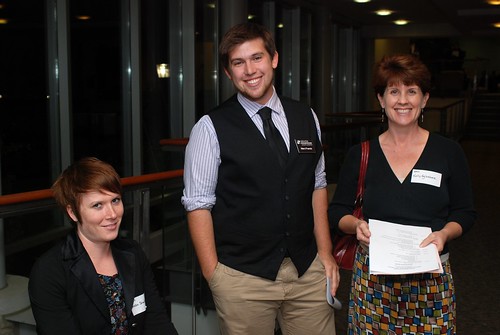 |
| L to R: Vanessa, new VISTA member Marc Francis, and Barclay Community School Director Kelly Oglesbee |
After November, I’m not sure where I'm headed. I am actively looking for job opportunities, but I'm not done traveling yet. I may continue living here and traveling periodically, or I may move to a different state and experience that for a while. Either way, being 23, I don’t feel too terribly anxious about making concrete plans.
Give us the outsider’s perspective—when you moved here, what surprised you most about this city? What do you think is its biggest strength? Biggest weakness?
What surprised me most about Baltimore was how different each neighborhood was while still being in such close proximity to one another. The discrepancy of wealth, the culture of the region, the architecture, everything varied within blocks of each other, and I had never in my life seen that. The biggest strength I found was the sense of community and the willingness of people to work together towards what they want for themselves, their families, and their communities. It may have to do with the history of the city, but the community is something Baltimore should be really proud of.
It’s harder to pin down Baltimore’s greatest weakness. Honestly, it might be something as difficult to fix as the lack of money, or the lack of employment opportunities. These issues breed the street-level problems we see on a daily basis, and unfortunately, it’s a weakness that a lot of towns and cities are facing right now.
If you could say one thing to people just starting their year of service, what would it be?
Just go with it. It will probably be one of the strangest years of your life, and possibly one of the most difficult, but it’s definitely worth it and you’ll learn a lot. Keep your sense of humor and just go with it.
Subscribe to:
Posts (Atom)